



Bedankt voor het vertrouwen het afgelopen jaar! Om jou te bedanken bieden we GRATIS verzending (in België) aan op alles gedurende de hele maand januari.
- Afhalen na 1 uur in een winkel met voorraad
- In januari gratis thuislevering in België
- Ruim aanbod met 7 miljoen producten
Bedankt voor het vertrouwen het afgelopen jaar! Om jou te bedanken bieden we GRATIS verzending (in België) aan op alles gedurende de hele maand januari.
- Afhalen na 1 uur in een winkel met voorraad
- In januari gratis thuislevering in België
- Ruim aanbod met 7 miljoen producten





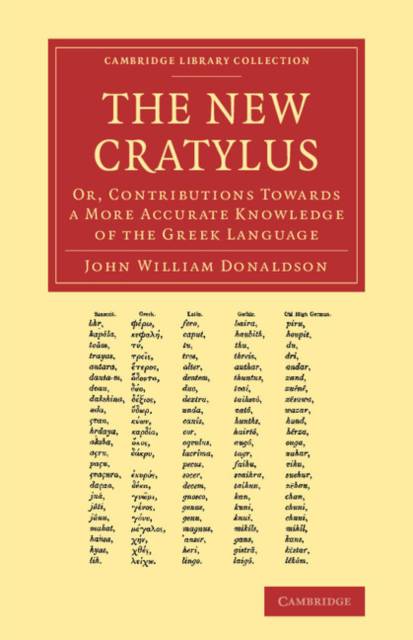
The New Cratylus
Or, Contributions Towards a More Accurate Knowledge of the Greek Language
John William Donaldson
€ 111,45
+ 222 punten
Omschrijving
The philologist and biblical critic John William Donaldson (1811-61) published this pioneering work in 1839. It is an attempt to apply the principles of comparative philology to ancient Greek, elucidating the grammar and syntax of the language by comparing it with actual or conjectural cognate languages. As well as producing a great deal of original research on the subject, Donaldson was the first British philologist to bring the work of continental scholars to the attention of English readers. In the book's first section, he gives a history of philology, surveys its present state and expounds a philosophy of language. Here he sets Greek in the context of other Indo-European languages, and outlines a theory of the Greek alphabet and its origins. In the second section, he examines pronouns, numerals, prepositions and particles before considering the noun in the third section, and finally the various tenses and moods of the verb in the fourth section.
Specificaties
Betrokkenen
- Auteur(s):
- Uitgeverij:
Inhoud
- Aantal bladzijden:
- 616
- Taal:
- Engels
- Reeks:
Eigenschappen
- Productcode (EAN):
- 9781108062145
- Verschijningsdatum:
- 26/09/2013
- Uitvoering:
- Paperback
- Formaat:
- Trade paperback (VS)
- Afmetingen:
- 140 mm x 216 mm
- Gewicht:
- 771 g


Alleen bij Standaard Boekhandel
+ 222 punten op je klantenkaart van Standaard Boekhandel
SOLDEN


Beoordelingen
We publiceren alleen reviews die voldoen aan de voorwaarden voor reviews. Bekijk onze voorwaarden voor reviews.