


- Afhalen na 1 uur in een winkel met voorraad
- Gratis thuislevering in België vanaf € 30
- Ruim aanbod met 7 miljoen producten
- Afhalen na 1 uur in een winkel met voorraad
- Gratis thuislevering in België vanaf € 30
- Ruim aanbod met 7 miljoen producten





€ 83,95
+ 167 punten
Omschrijving
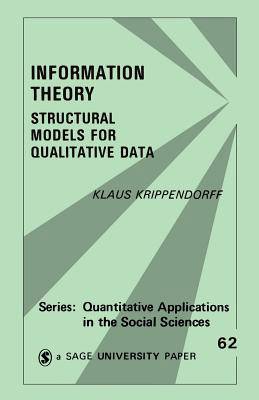
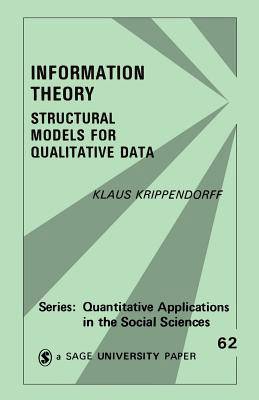
Information theory always has the dual appeal of bringing important concepts to the study of communication in society, and of providing a calculus for information flows within systems. This book introduces readers to basic concepts of information theory, extending its original linear conception of communication to many variables, networks, and higher-order interactions (including loops) and developing it into a method for analyzing qualitative data. It elaborates on the algebra of entropy and information, shows how complex models of data are constructed and tested, describes algorithms for exploring multivariate structures using such models, and gives illustrative applications of these techniques. The book is designed as a text but it can also serve as a handbook for social researchers and systems theorists with an interest in communication.
Specificaties
Betrokkenen
- Auteur(s):
- Uitgeverij:
Inhoud
- Aantal bladzijden:
- 96
- Taal:
- Engels
- Reeks:
- Reeksnummer:
- nr. 62
Eigenschappen
- Productcode (EAN):
- 9780803921320
- Verschijningsdatum:
- 1/09/1986
- Uitvoering:
- Paperback
- Formaat:
- Trade paperback (VS)
- Afmetingen:
- 130 mm x 214 mm
- Gewicht:
- 117 g


Alleen bij Standaard Boekhandel
+ 167 punten op je klantenkaart van Standaard Boekhandel
Cadeau

AANGERADEN


Beoordelingen
We publiceren alleen reviews die voldoen aan de voorwaarden voor reviews. Bekijk onze voorwaarden voor reviews.