


- Afhalen na 1 uur in een winkel met voorraad
- Gratis thuislevering in België vanaf € 30
- Ruim aanbod met 7 miljoen producten
- Afhalen na 1 uur in een winkel met voorraad
- Gratis thuislevering in België vanaf € 30
- Ruim aanbod met 7 miljoen producten





Omschrijving
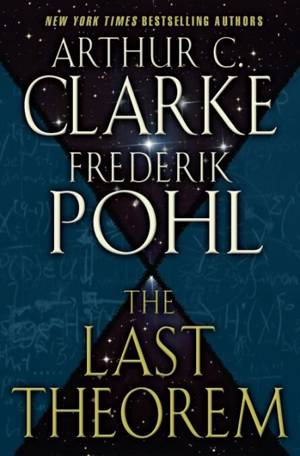
Two of science fiction’s most renowned writers join forces for a storytelling sensation. The historic collaboration between Frederik Pohl and his fellow founding father of the genre, Arthur C. Clarke, is both a momentous literary event and a fittingly grand farewell from the late, great visionary author of 2001: A Space Odyssey.
The Last Theorem is a story of one man’s mathematical obsession, and a celebration of the human spirit and the scientific method. It is also a gripping intellectual thriller in which humanity, facing extermination from all-but-omnipotent aliens, the Grand Galactics, must overcome differences of politics and religion and come together . . . or perish.
In 1637, the French mathematician Pierre de Fermat scrawled a note in the margin of a book about an enigmatic theorem: “I have discovered a truly marvelous proof of this proposition which this margin is too narrow to contain.” He also neglected to record his proof elsewhere. Thus began a search for the Holy Grail of mathematics–a search that didn’t end until 1994, when Andrew Wiles published a 150-page proof. But the proof was burdensome, overlong, and utilized mathematical techniques undreamed of in Fermat’s time, and so it left many critics unsatisfied–including young Ranjit Subramanian, a Sri Lankan with a special gift for mathematics and a passion for the famous “Last Theorem.”
When Ranjit writes a three-page proof of the theorem that relies exclusively on knowledge available to Fermat, his achievement is hailed as a work of genius, bringing him fame and fortune. But it also brings him to the attention of the National Security Agency and a shadowy United Nations outfit called Pax per Fidem, or Peace Through Transparency, whose secretive workings belie its name. Suddenly Ranjit–together with his wife, Myra de Soyza, an expert in artificial intelligence, and their burgeoning family–finds himself swept up in world-shaking events, his genius for abstract mathematical thought put to uses that are both concrete and potentially deadly.
Meanwhile, unbeknownst to anyone on Earth, an alien fleet is approaching the planet at a significant percentage of the speed of light. Their mission: to exterminate the dangerous species of primates known as homo sapiens.
The Last Theorem is a story of one man’s mathematical obsession, and a celebration of the human spirit and the scientific method. It is also a gripping intellectual thriller in which humanity, facing extermination from all-but-omnipotent aliens, the Grand Galactics, must overcome differences of politics and religion and come together . . . or perish.
In 1637, the French mathematician Pierre de Fermat scrawled a note in the margin of a book about an enigmatic theorem: “I have discovered a truly marvelous proof of this proposition which this margin is too narrow to contain.” He also neglected to record his proof elsewhere. Thus began a search for the Holy Grail of mathematics–a search that didn’t end until 1994, when Andrew Wiles published a 150-page proof. But the proof was burdensome, overlong, and utilized mathematical techniques undreamed of in Fermat’s time, and so it left many critics unsatisfied–including young Ranjit Subramanian, a Sri Lankan with a special gift for mathematics and a passion for the famous “Last Theorem.”
When Ranjit writes a three-page proof of the theorem that relies exclusively on knowledge available to Fermat, his achievement is hailed as a work of genius, bringing him fame and fortune. But it also brings him to the attention of the National Security Agency and a shadowy United Nations outfit called Pax per Fidem, or Peace Through Transparency, whose secretive workings belie its name. Suddenly Ranjit–together with his wife, Myra de Soyza, an expert in artificial intelligence, and their burgeoning family–finds himself swept up in world-shaking events, his genius for abstract mathematical thought put to uses that are both concrete and potentially deadly.
Meanwhile, unbeknownst to anyone on Earth, an alien fleet is approaching the planet at a significant percentage of the speed of light. Their mission: to exterminate the dangerous species of primates known as homo sapiens.
Specificaties
Betrokkenen
- Auteur(s):
- Uitgeverij:
Inhoud
- Aantal bladzijden:
- 320
- Taal:
- Engels
Eigenschappen
- Productcode (EAN):
- 9780345509680
- Verschijningsdatum:
- 4/08/2008
- Uitvoering:
- E-book
- Beveiligd met:
- Adobe DRM
- Formaat:
- ePub


Alleen bij Standaard Boekhandel
+ 11 punten op je klantenkaart van Standaard Boekhandel
AANGERADEN


Beoordelingen
We publiceren alleen reviews die voldoen aan de voorwaarden voor reviews. Bekijk onze voorwaarden voor reviews.