


- Afhalen na 1 uur in een winkel met voorraad
- Gratis thuislevering in België vanaf € 30
- Ruim aanbod met 7 miljoen producten
- Afhalen na 1 uur in een winkel met voorraad
- Gratis thuislevering in België vanaf € 30
- Ruim aanbod met 7 miljoen producten





€ 74,95
+ 149 punten
Omschrijving
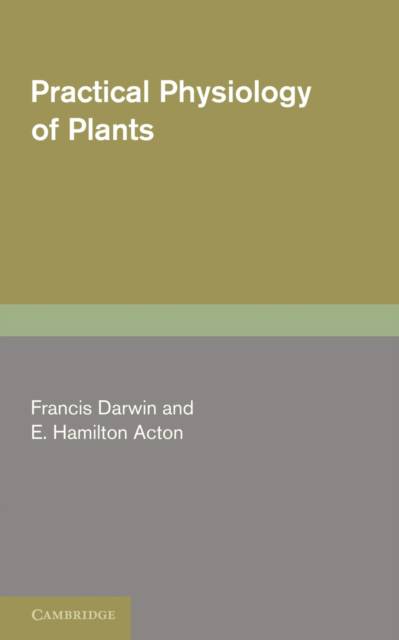
Published in 1895, this is the second edition of an original 1894 volume. It was co-authored by Edward Hamilton Acton (1862-95) and Francis Darwin (1848-1925), a son of Charles Darwin, who worked with his father on a series of experiments dealing with plant movement. The text is the product of a course of instruction in the physiology of plants given at Cambridge University. To enable the students to carry out their work effectively written instructions were needed, and these instructions were elaborated to form the basis of the book. It is divided into two sections: section one deals with general physiology and is of a more elementary character; part two deals with the chemistry of metabolism and is necessarily more complicated. This book will be of value to anyone with an interest in botany, science education or the history of science.
Specificaties
Betrokkenen
- Auteur(s):
- Uitgeverij:
Inhoud
- Aantal bladzijden:
- 366
- Taal:
- Engels
Eigenschappen
- Productcode (EAN):
- 9780521230803
- Verschijningsdatum:
- 9/06/2011
- Uitvoering:
- Paperback
- Formaat:
- Trade paperback (VS)
- Afmetingen:
- 127 mm x 203 mm
- Gewicht:
- 394 g


Alleen bij Standaard Boekhandel
+ 149 punten op je klantenkaart van Standaard Boekhandel
AANGERADEN


Beoordelingen
We publiceren alleen reviews die voldoen aan de voorwaarden voor reviews. Bekijk onze voorwaarden voor reviews.