


- Afhalen na 1 uur in een winkel met voorraad
- Gratis thuislevering in België vanaf € 30
- Ruim aanbod met 7 miljoen producten
- Afhalen na 1 uur in een winkel met voorraad
- Gratis thuislevering in België vanaf € 30
- Ruim aanbod met 7 miljoen producten




Omschrijving
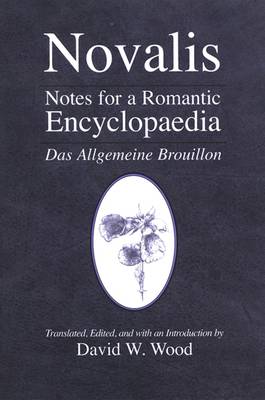
Novalis is best known in history as the poet of early German Romanticism. However, this translation of Das Allgemeine Brouillon, or "Universal Notebook," finally introduces him to the English-speaking world as an extraordinarily gifted philosopher in his own right and shatters the myth of him as a mere daydreaming and irrational poet. Composed of more than 1,100 notebook entries, this is easily Novalis's largest theoretical work and certainly one of the most remarkable and audacious undertakings of the "Golden Age" of German philosophy. In it, Novalis reflects on numerous aspects of human culture, including philosophy, poetry, the natural sciences, the fine arts, mathematics, mineralogy, history, and religion, and brings them all together into what he calls a "Romantic Encyclopaedia" or "Scientific Bible."
Novalis's Romantic Encyclopaedia fully embodies the author's own personal brand of philosophy, "Magical Idealism." With meditations on mankind and nature, the possible future development of our faculties of reason, imagination, and the senses, and the unification of the different sciences, these notes contain a veritable treasure trove of richly poetic and philosophic thoughts.
Novalis's Romantic Encyclopaedia fully embodies the author's own personal brand of philosophy, "Magical Idealism." With meditations on mankind and nature, the possible future development of our faculties of reason, imagination, and the senses, and the unification of the different sciences, these notes contain a veritable treasure trove of richly poetic and philosophic thoughts.
Specificaties
Betrokkenen
- Auteur(s):
- Vertaler(s):
- Uitgeverij:
Inhoud
- Aantal bladzijden:
- 320
- Taal:
- Engels
- Reeks:
Eigenschappen
- Productcode (EAN):
- 9780791469743
- Verschijningsdatum:
- 2/07/2011
- Uitvoering:
- Paperback
- Formaat:
- Trade paperback (VS)
- Afmetingen:
- 155 mm x 228 mm
- Gewicht:
- 435 g


Alleen bij Standaard Boekhandel
+ 112 punten op je klantenkaart van Standaard Boekhandel
Cadeau

AANGERADEN


Beoordelingen
We publiceren alleen reviews die voldoen aan de voorwaarden voor reviews. Bekijk onze voorwaarden voor reviews.