


- Afhalen na 1 uur in een winkel met voorraad
- Gratis thuislevering in België vanaf € 30
- Ruim aanbod met 7 miljoen producten
- Afhalen na 1 uur in een winkel met voorraad
- Gratis thuislevering in België vanaf € 30
- Ruim aanbod met 7 miljoen producten





Omschrijving
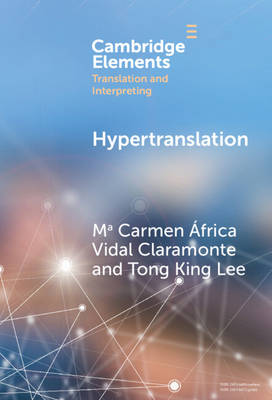
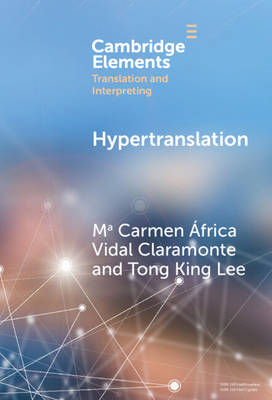
Hypertranslation refers to a vast and virtual field of mobile relations comprising the interplay of signs across languages, modes, and media. In hypertranslation, the notions of source/target, directionality, and authenticity are set in perpetual flow and flux, resulting in a many-to-many interactive dynamic. Using illustrations drawn from a wide range of literary and artistic experiments, this Element proposes hypertranslation as a theoretical lens on the heterogeneous, remediational, extrapolative, and networked nature of cultural and knowledge production, particularly in cyberspace. It considers how developments in artificial intelligence have led to an expansion in intersemiotic potentialities and the liquidation of imagined boundaries. Exploring the translational aspects of our altered semiotic ecology, where the production, circulation, consumption, and recycling of memes extend beyond human intellect and creativity, this Element positions hypertranslation as a fundamental condition of contemporary posthuman communication in Web 5.0 and beyond.
Specificaties
Betrokkenen
- Auteur(s):
- Uitgeverij:
Inhoud
- Aantal bladzijden:
- 80
- Taal:
- Engels
- Reeks:
Eigenschappen
- Productcode (EAN):
- 9781009518802
- Verschijningsdatum:
- 16/01/2025
- Uitvoering:
- Hardcover
- Formaat:
- Genaaid
- Afmetingen:
- 152 mm x 229 mm
- Gewicht:
- 281 g


Alleen bij Standaard Boekhandel
+ 248 punten op je klantenkaart van Standaard Boekhandel
Cadeau

AANGERADEN


Beoordelingen
We publiceren alleen reviews die voldoen aan de voorwaarden voor reviews. Bekijk onze voorwaarden voor reviews.