


- Afhalen na 1 uur in een winkel met voorraad
- Gratis thuislevering in België vanaf € 30
- Ruim aanbod met 7 miljoen producten
- Afhalen na 1 uur in een winkel met voorraad
- Gratis thuislevering in België vanaf € 30
- Ruim aanbod met 7 miljoen producten





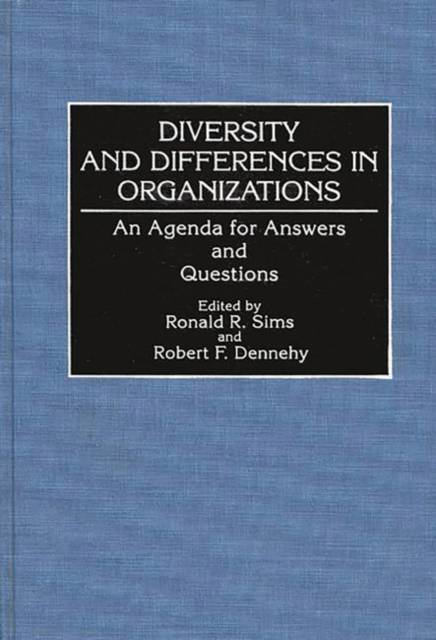
Diversity and Differences in Organizations
An Agenda for Answers and Questions
Robert P Dennehy, Ronald R Sims
Hardcover | Engels
€ 169,95
+ 339 punten
Omschrijving
Among the most significant features of Sims and Dennehy's book are a focus beyond valuing and managing cultural diversity, and a demonstration of the interdependency that exists between a number of important individual differences (i.e., alienation, receptivity, style, power). They discuss some personal yet theoretical insights on answers and questions that are important in increasing our recognition, understanding, and appreciation of diversity and differences in general. In eleven original essays contributors examine a wide assortment of behaviors, issues, and individual differences while offering their reflections on answers and future questions that are key to leveraging diversity and difference in organizations.
Recent literature has emphasized the projected changes in organizational demographics and the fact that globalization also is changing the face of organizational landscapes. Taken together these trends are serving to increase the need to understand and appreciate cultural diversity in virtually all organizations. Many books already exist that attempt to address this topic. Each one attempts to provide a guide to dealing with a variety of racial, ethnic, or cultural backgrounds. The intent of Sims and Dennehy's book is to go beyond offering ideas or to serve simply as a guide to improve the management of diversity. Thus, a major goal of this book is to have its readers reflect on their personal diversity and difference experiences and to create a forum for answers and questions on the value of diversity and differences for all. The main thread that ties everything together in this book is the strategy of creating value through repeated emphasis on our need to look beyond valuing and managing diversity to the interdependency of a variety of individual variables that shape our lives. The book begins by offering a bridge-building model as a tool that colleges and universities can use to decrease the alienation experienced by minority students on predominantly white campuses and to increase the social consciousness of all institutional constituents. The next chapter suggests that diversity is essential to learning, and good conversation is a powerful way to learn from diversity. The book then introduces a model that seeks to place the issue of diversity management as one part of an overall development change process. The notion that the success of some organizations in enhancing diversity is dependent upon the vision and strength of management is emphasized in the next chapter, which, by taking a different perspective, presents the argument that current corporate infrastructures do not promote diversity. Unless a company builds new internal support systems that encourage diversity of thought and action, employees hired to make the company more diverse will merely be homogenized into the prevailing culture. In the following chapter the role of training in U.S. organizations is discussed as a major component in increasing the recognition, understanding, and appreciation of diversity and difference. The concept of difference-based approach to advocacy and its relation to issues of gender are introduced as cornerstones of creating work environments that are supportive of employees' needs to balance work and family. The next chapter provides data for analysis of the expatriate's learning experience and applies the learning from expatriate experiences to those issues faced by minorities in a domestic setting. A need to create new intellectual diversity that focuses on foreign language skills applicable to the needs of economic, scientific, and technological markets is emphasized in the next chapter. Next, a comparison is made of the decision-making processes and practices of Japanese and American managers at a Japanese company in the United States. The author's pioneering findings can be generalized to understand decision-making in different cultures and organizations. The role of diversity educator is then discussed and the author persuasively argues that active learner participation, self-disclosure, and a trusting supportive environment are prerequisites to understanding and appreciating diversity. The book concludes with a review of the important points discussed by the contributors to this book, offers questions in need of answers, and identifies future issues on diversity and differences.Specificaties
Betrokkenen
- Auteur(s):
- Uitgeverij:
Inhoud
- Aantal bladzijden:
- 208
- Taal:
- Engels
Eigenschappen
- Productcode (EAN):
- 9780899307985
- Verschijningsdatum:
- 28/07/1993
- Uitvoering:
- Hardcover
- Formaat:
- Genaaid
- Afmetingen:
- 162 mm x 244 mm
- Gewicht:
- 494 g


Alleen bij Standaard Boekhandel
+ 339 punten op je klantenkaart van Standaard Boekhandel
Wedstrijd


Beoordelingen
We publiceren alleen reviews die voldoen aan de voorwaarden voor reviews. Bekijk onze voorwaarden voor reviews.