


- Afhalen na 1 uur in een winkel met voorraad
- Gratis thuislevering in België vanaf € 30
- Ruim aanbod met 7 miljoen producten
- Afhalen na 1 uur in een winkel met voorraad
- Gratis thuislevering in België vanaf € 30
- Ruim aanbod met 7 miljoen producten





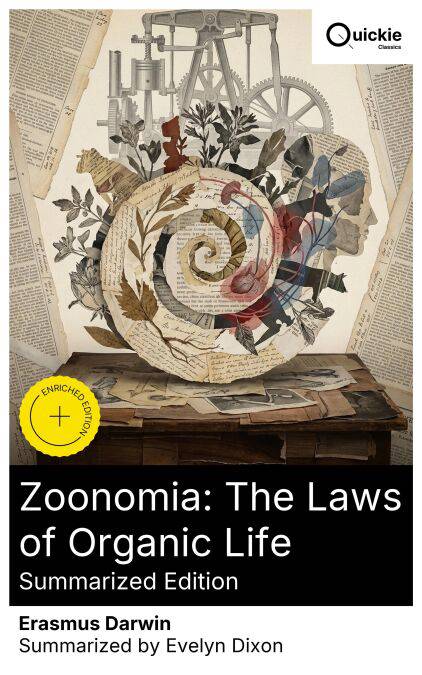
Zoonomia: The Laws of Organic Life (Summarized Edition) E-BOOK
Enriched edition. An 18th-Century Treatise on Evolutionary Theory, Psychophysiology, and the Classification of Pathology
Erasmus Darwin
E-book | Engels
€ 1,99
+ 1 punten
Omschrijving
Zoonomia: The Laws of Organic Life (1794–1796) advances Erasmus Darwin's system of physiology and pathology, classifying diseases while deriving function from a unified sensorium—irritation, sensation, volition, association. In lucid, speculative prose that interleaves case histories with mechanical analogy, the treatise explains organic processes by natural causes and even posits life's development from a "living filament," bridging Enlightenment medicine and early evolutionary thought. A Lichfield physician and central figure in the Lunar Society, Darwin fused decades of bedside observation with the mechanizing spirit of Watt, Wedgwood, and Priestley. Poet of The Botanic Garden and reader of Cullen and Haller, he married clinical pragmatism to experimental philosophy, a reformist temper, and curiosity about generation—impulses that drove him to codify disease and hazard organic transmutation. Students of Enlightenment medicine, the prehistory of evolution, and the literature of science will find in Zoonomia a bracing mix of precise observation and audacious system-building. Read it for its capacious curiosity, its provocative errors, and its formative influence on nineteenth-century biology, including his grandson.
Quickie Classics summarizes timeless works with precision, preserving the author's voice and keeping the prose clear, fast, and readable—distilled, never diluted. Enriched Edition extras: Introduction · Synopsis · Historical Context · Brief Analysis · 4 Reflection Q&As · Editorial Footnotes.
Quickie Classics summarizes timeless works with precision, preserving the author's voice and keeping the prose clear, fast, and readable—distilled, never diluted. Enriched Edition extras: Introduction · Synopsis · Historical Context · Brief Analysis · 4 Reflection Q&As · Editorial Footnotes.
Specificaties
Betrokkenen
- Auteur(s):
- Uitgeverij:
Inhoud
- Aantal bladzijden:
- 336
- Taal:
- Engels
Eigenschappen
- Productcode (EAN):
- 8596547882282
- Verschijningsdatum:
- 9/01/2026
- Uitvoering:
- E-book
- Beveiligd met:
- Digital watermarking
- Formaat:
- ePub


Alleen bij Standaard Boekhandel
+ 1 punten op je klantenkaart van Standaard Boekhandel
Cadeau

AANGERADEN


Beoordelingen
We publiceren alleen reviews die voldoen aan de voorwaarden voor reviews. Bekijk onze voorwaarden voor reviews.