


- Afhalen na 1 uur in een winkel met voorraad
- Gratis thuislevering in België vanaf € 30
- Ruim aanbod met 7 miljoen producten
- Afhalen na 1 uur in een winkel met voorraad
- Gratis thuislevering in België vanaf € 30
- Ruim aanbod met 7 miljoen producten





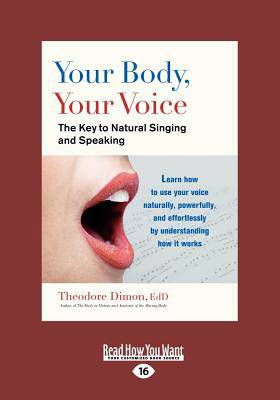
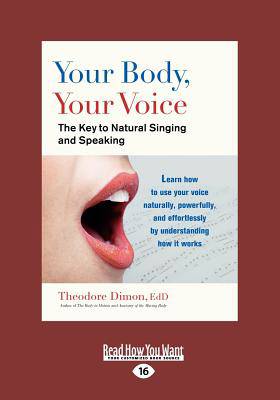
Your Body, Your Voice
The Key to Natural Singing and Speaking (Large Print 16pt)
Theodore Dimon
Paperback | Engels
€ 39,45
+ 78 punten
Uitvoering
Omschrijving
In this innovative book, Theodore Dimon, EdD, shows how each part of the vocal organ (breathing, larynx, throat, and so on) works as part of a larger musculoskeletal system that is often interfered with, and how identifying this larger system and understanding in a practical way how it works allows a person to train and improve the voice, whether speaking or singing. Traditional vocal training methods, says Dimon, cannot be effective without restoring the functioning of the musculature that supports the voice. Enhanced with over 50 detailed full - color illustrations, the book discusses the fallacy of traditional breathing exercises and explains that the key to efficient breathing lies in the expansive support of the trunk and rib cage. Investigating the elements needed to produce a strong supported tone, Dimon describes the importance of voice ''placement, '' or directing the sound to a part of the body in order to produce a fully rounded, resonant tone. He identifies harmful patterns of speech and singing, and offers helpful methods for reestablishing the natural function of the vocal mechanism. Individual chapters cover elements of the whispered ''ah, '' producing a pure sung tone, vocal registers, the suspensory muscles of the larynx, and more.
Specificaties
Betrokkenen
- Auteur(s):
- Uitgeverij:
Inhoud
- Aantal bladzijden:
- 298
- Taal:
- Engels
Eigenschappen
- Productcode (EAN):
- 9781459630666
- Verschijningsdatum:
- 19/10/2011
- Uitvoering:
- Paperback
- Formaat:
- Trade paperback (VS)
- Afmetingen:
- 178 mm x 254 mm
- Gewicht:
- 521 g


Alleen bij Standaard Boekhandel
+ 78 punten op je klantenkaart van Standaard Boekhandel
Cadeau

AANGERADEN


Beoordelingen
We publiceren alleen reviews die voldoen aan de voorwaarden voor reviews. Bekijk onze voorwaarden voor reviews.