



Bedankt voor het vertrouwen het afgelopen jaar! Om jou te bedanken bieden we GRATIS verzending (in België) aan op alles gedurende de hele maand januari.
- Afhalen na 1 uur in een winkel met voorraad
- In januari gratis thuislevering in België
- Ruim aanbod met 7 miljoen producten
Bedankt voor het vertrouwen het afgelopen jaar! Om jou te bedanken bieden we GRATIS verzending (in België) aan op alles gedurende de hele maand januari.
- Afhalen na 1 uur in een winkel met voorraad
- In januari gratis thuislevering in België
- Ruim aanbod met 7 miljoen producten





€ 167,95
+ 335 punten
Uitvoering
Omschrijving
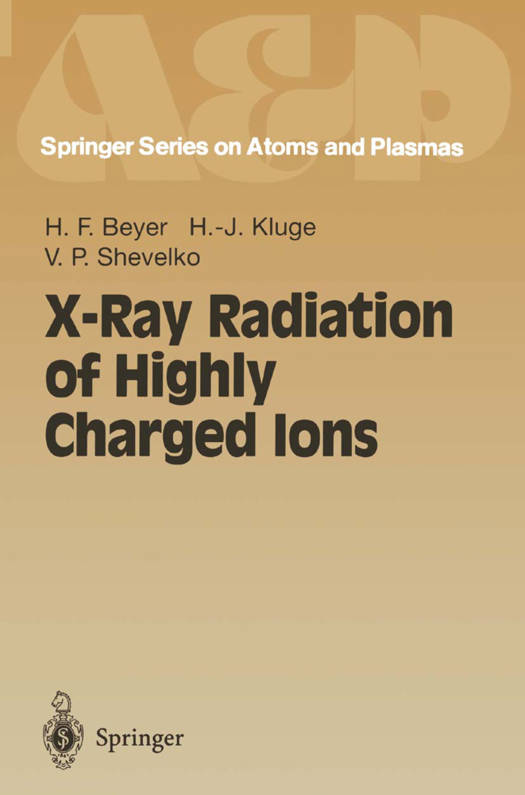
The physics of highly charged ions continues to be one of the most active and interesting fields of atomic physics. A large fraction of the characteristic radiation of such ions lies in the x-ray region and its spectroscopy represents an important experimental tool. The field of x-ray spectroscopy grew directly from the discovery of x radiation by Wilhelm Conrad Rontgen in 1895. The early contributions to atomic physics that arose out of x-ray spectroscopy are well documented and are the subject of many centennial events. In the past, the gross features of most x-ray spectra in the hard x-ray region have been accounted for on a hydrogenic model. In many instances the gross spectral features recorded in the early days of x-ray physics match those observed with state-of-the-art techniques today and many of the early qualitative - terpretations have remained unchanged. It is in the details of the spectra that today's results are superior to those obtained many years ago, and it is in the quantitative and accurate - scriptions that today's predictions are better. A rejuvenation of the field has occurred after the great achievements in the development of new ion sources for production of heavy ions with only one or few electrons. The new tools available to the experimenter allow the exploration of new states of m- ter and allow us to challenge new frontiers in our theoretical understanding of atoms and their interactions with other particles.
Specificaties
Betrokkenen
- Auteur(s):
- Uitgeverij:
Inhoud
- Aantal bladzijden:
- 233
- Taal:
- Engels
- Reeks:
- Reeksnummer:
- nr. 19
Eigenschappen
- Productcode (EAN):
- 9783642083235
- Verschijningsdatum:
- 9/12/2010
- Uitvoering:
- Paperback
- Formaat:
- Trade paperback (VS)
- Afmetingen:
- 156 mm x 234 mm
- Gewicht:
- 353 g


Alleen bij Standaard Boekhandel
+ 335 punten op je klantenkaart van Standaard Boekhandel
SOLDEN


Beoordelingen
We publiceren alleen reviews die voldoen aan de voorwaarden voor reviews. Bekijk onze voorwaarden voor reviews.