


- Afhalen na 1 uur in een winkel met voorraad
- Gratis thuislevering in België vanaf € 30
- Ruim aanbod met 7 miljoen producten
- Afhalen na 1 uur in een winkel met voorraad
- Gratis thuislevering in België vanaf € 30
- Ruim aanbod met 7 miljoen producten





Omschrijving
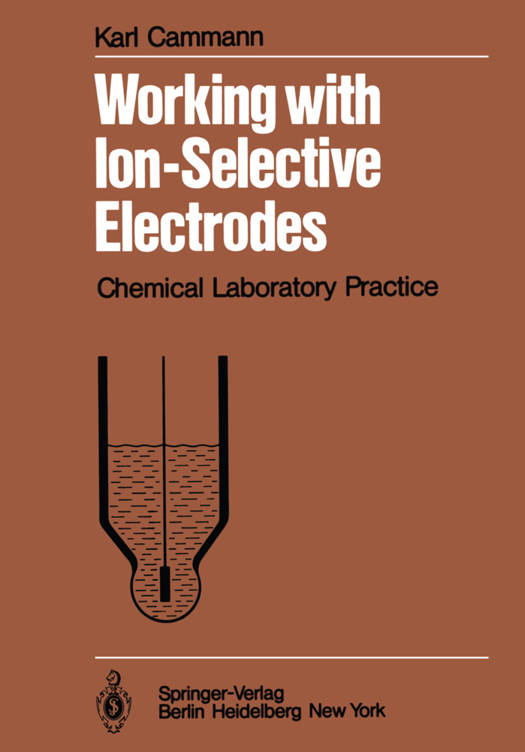
The first section introduces the electrochemical nomenclature necessary for under- standing the literature on ion-selective electrodes and discusses the general principles behind all electrodes. The second section is concerned with the problems which arise in any accurate elec- trode potential measurement in practice. Here the most important reference electrodes are discussed with special reference to their use in conjunction with ion-selective elec- trodes. From experience, almost 75% of all problems which arise when working with ion-selective electrodes are on account of the reference electrode. After the reader is aquainted with the basic problems involved, the third section deals with individual ion-selective electrodes; their properties, handling and methods of pre- paration. Here the discussion of these electrodes is not arranged according to the spe- cies detected, but rather according to the kind of construction, since from this view- point characteristic properties are much the same and handling procedures need only be described once for an entire series of similar electrodes. The fourth section discusses amplifiers. Here the problems of high-ohmic EMF meas- urements such as noise level, insulation, static charging and ground loops are discussed. The fifth section is devoted to the various evaluation methods. Here a few schemes and examples are provided to indicate optimum practical procedures and the accura- cies attainable with the various methods are discussed. The last section describes special set-ups such as clinical flow-thru cells, microelec- trodes for measuring intracellular ionic activities, industrial on-line techniques and continuous environmental protection monitors.
Specificaties
Betrokkenen
- Auteur(s):
- Vertaler(s):
- Uitgeverij:
Inhoud
- Aantal bladzijden:
- 226
- Taal:
- Engels
- Reeks:
Eigenschappen
- Productcode (EAN):
- 9783642672781
- Verschijningsdatum:
- 15/11/2011
- Uitvoering:
- Paperback
- Formaat:
- Trade paperback (VS)
- Afmetingen:
- 170 mm x 244 mm
- Gewicht:
- 394 g


Alleen bij Standaard Boekhandel
+ 324 punten op je klantenkaart van Standaard Boekhandel
Wedstrijd


Beoordelingen
We publiceren alleen reviews die voldoen aan de voorwaarden voor reviews. Bekijk onze voorwaarden voor reviews.