


- Afhalen na 1 uur in een winkel met voorraad
- Gratis thuislevering in België vanaf € 30
- Ruim aanbod met 7 miljoen producten
- Afhalen na 1 uur in een winkel met voorraad
- Gratis thuislevering in België vanaf € 30
- Ruim aanbod met 7 miljoen producten





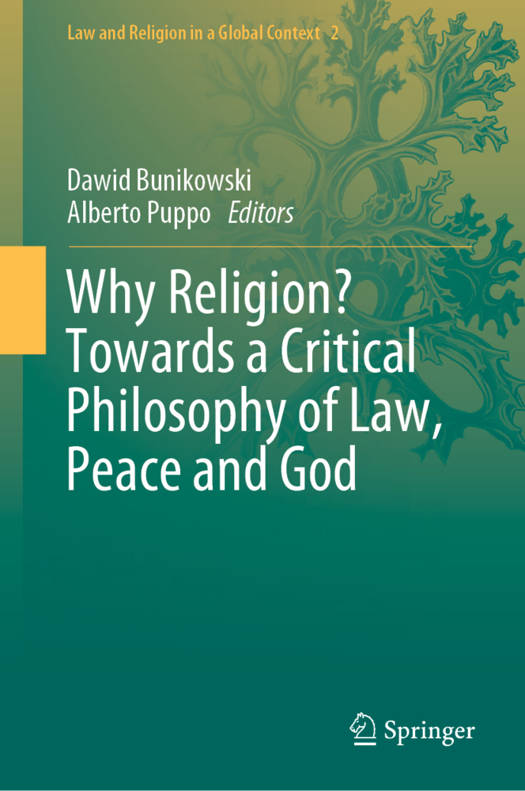
Why Religion? Towards a Critical Philosophy of Law, Peace and God
€ 244,45
+ 488 punten
Omschrijving
This book examines the relation between religion and jurisprudence, God, and peace respectively. It argues that in order to elucidate the possible role religion can play in the contemporary world, it is useful to analyse religion by associating it with other concepts. Why peace? Because peace is probably the greatest promise made by religions and the greatest concern in the contemporary world. Why jurisprudence? Because, quoting Kelsen's famous book "Peace through Law", peace is usually understood as something achievable by international legal instruments. But what if we replace "Peace through Law" with "Peace through Religion"? Does law, as an instrument for achieving peace, incorporate a religious dimension? Is law, ultimately, a religious and normative construction oriented to peace, to the protection of humanity, in order to keep humans from the violence of nature? Is the hope for peace rational, or just a question of faith? Is religion itself a question of faith or a rational choice? Is the relatively recent legal concept of "responsibility to protect" a secular expression of the oldest duty of humankind?
The book follows the structure of interdisciplinary research in which the international legal scholar, the moral philosopher, the philosopher of religion, the theologian, and the political scientist contribute to the construction of the necessary bridges. Moreover, it gives voice to different monotheistic traditions and, more importantly, it analyses religion in the various dimensions in which it determines the authors' cultures: as a set of rituals, as a source of moral norms, as a universal project for peace, and as a political discourse.
The book follows the structure of interdisciplinary research in which the international legal scholar, the moral philosopher, the philosopher of religion, the theologian, and the political scientist contribute to the construction of the necessary bridges. Moreover, it gives voice to different monotheistic traditions and, more importantly, it analyses religion in the various dimensions in which it determines the authors' cultures: as a set of rituals, as a source of moral norms, as a universal project for peace, and as a political discourse.
Specificaties
Betrokkenen
- Uitgeverij:
Inhoud
- Aantal bladzijden:
- 297
- Taal:
- Engels
- Reeks:
- Reeksnummer:
- nr. 2
Eigenschappen
- Productcode (EAN):
- 9783030354831
- Verschijningsdatum:
- 12/02/2020
- Uitvoering:
- Hardcover
- Formaat:
- Genaaid
- Afmetingen:
- 156 mm x 234 mm
- Gewicht:
- 612 g

Alleen bij Standaard Boekhandel
+ 488 punten op je klantenkaart van Standaard Boekhandel
Cadeau

AANGERADEN


Beoordelingen
We publiceren alleen reviews die voldoen aan de voorwaarden voor reviews. Bekijk onze voorwaarden voor reviews.