


- Afhalen na 1 uur in een winkel met voorraad
- Gratis thuislevering in België vanaf € 30
- Ruim aanbod met 7 miljoen producten
- Afhalen na 1 uur in een winkel met voorraad
- Gratis thuislevering in België vanaf € 30
- Ruim aanbod met 7 miljoen producten





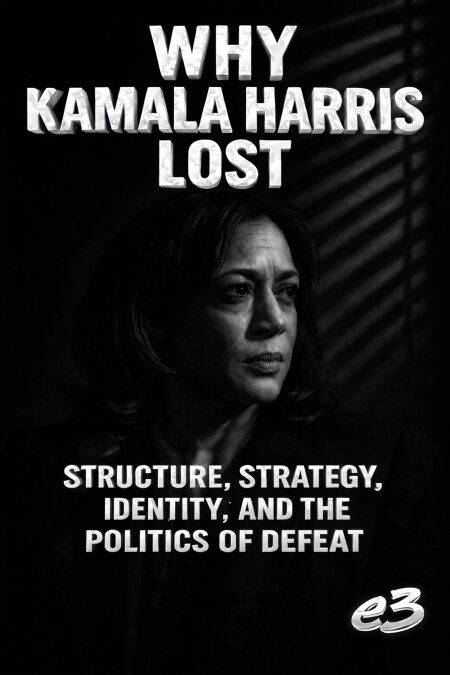
Why Kamala Harris Lost: Structure, Strategy, Identity, and the Politics of Defeat E-BOOK
e3
E-book | Engels
€ 28,99
+ 28 punten
Omschrijving
This book asks a simple question that resists simple answers: Why did Kamala Harris lose the 2024 presidential election?
On the surface, the outcome looks familiar. An incumbent party lost amid voter frustration over the economy, immigration, and global instability. A polarizing challenger returned to office by assembling an electorally efficient coalition. Analysts rushed forward with explanations—some confident, many partial, most shaped by prior assumptions about how elections ought to work.
This book is written in the conviction that the result deserves a slower, more comparative, and more disciplined analysis than the immediate post-election cycle allows.
Rather than advancing a single thesis or partisan verdict, the chapters that follow treat the election as a multi-causal event—one in which structural conditions, campaign strategy, demographic change, cultural dynamics, and institutional choices interacted in uneven ways across states and voter groups. Each chapter examines one major explanatory lens, compares competing accounts within that lens, evaluates the strongest available evidence, and flags what remains uncertain or contested.
Three principles guide the approach.
First, no single explanation is sufficient. Economic dissatisfaction, turnout decline, coalition realignment, racial and gender bias, campaign execution, and party decision-making all played roles—but not uniformly, and not always in the ways their advocates claim. The task is not to choose between them prematurely, but to understand how they overlap and where they diverge.
Second, turnout and persuasion are treated as analytically distinct outcomes, not interchangeable symptoms of support or enthusiasm. A central theme of the book is that modern elections can be lost not only because voters change their minds, but because they decide participation no longer feels consequential. Several chapters return to this distinction, showing how different mechanisms dominated in different states.
Third, the book aims to separate what we know with confidence from what we infer, and from what we still do not know. Where claims rest on strong empirical foundations—validated-voter studies, turnout data, consistent state-level patterns—they are identified as such. Where evidence is suggestive, mixed, or incomplete, that uncertainty is stated plainly. Citations are provided for the most load-bearing claims so readers can pursue the underlying research directly.
The structure of the book reflects this comparative ambition. Early chapters lay out the core puzzle and the dominant analytic frames used by scholars and commentators. Middle chapters trace what changed in the electorate, how the Harris campaign operated, what it communicated, and how the opposition succeeded. Later chapters examine cultural dynamics, party institutions, historical parallels, and competing post-election prescriptions before concluding with what can reasonably be said—and what remains open for future research.
This is not a campaign memoir, a polemic, or an attempt to assign moral blame. It is an effort to understand how contemporary American elections are increasingly decided, and what the 2024 result reveals about the evolving relationship between voters, parties, and political participation itself.
If the book has an underlying wager, it is this: that careful comparison and analytic restraint ultimately offer more insight than certainty delivered too quickly.



Alleen bij Standaard Boekhandel
+ 28 punten op je klantenkaart van Standaard Boekhandel
Cadeau

AANGERADEN


Beoordelingen
We publiceren alleen reviews die voldoen aan de voorwaarden voor reviews. Bekijk onze voorwaarden voor reviews.