


- Afhalen na 1 uur in een winkel met voorraad
- Gratis thuislevering in België vanaf € 30
- Ruim aanbod met 7 miljoen producten
- Afhalen na 1 uur in een winkel met voorraad
- Gratis thuislevering in België vanaf € 30
- Ruim aanbod met 7 miljoen producten





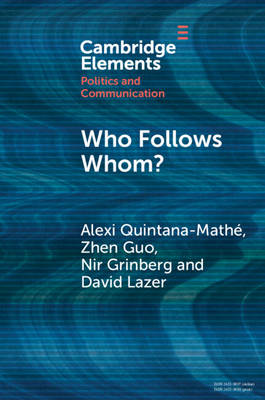
Who Follows Whom?
The Role of Geography and Similarity in Online Attention Networks
Alexi Quintana-Mathé, Zhen Guo, Nir Grinberg, David Lazer
€ 24,45
+ 48 punten
Uitvoering
Omschrijving
Follower ties play a major role in many social media platforms, representing users' choices on what content to pay attention to. This Element examines the role of geography and similarity by gender, age, race, and partisanship with respect to attention in social media by studying the follower ties among 1.1 million Twitter accounts matched to U.S. voter records. We find that geographic proximity is the dominant predictor of follower ties, and that demographic similarity by age and race/ethnicity are quite important. Surprisingly, given the prominence of political polarization in the contemporary US, partisanship plays a relatively minor role. In addition, our results indicate that the tendency to follow nearby users leads to following users of the same race/ethnicity and partisanship. Our findings highlight the enduring significance of physical geography in virtual spaces and that political preference is not a dominant determinant of online attention in social media.
Specificaties
Betrokkenen
- Auteur(s):
- Uitgeverij:
Inhoud
- Aantal bladzijden:
- 75
- Taal:
- Engels
- Reeks:
Eigenschappen
- Productcode (EAN):
- 9781009695893
- Verschijningsdatum:
- 30/06/2026
- Uitvoering:
- Paperback
- Formaat:
- Trade paperback (VS)


Alleen bij Standaard Boekhandel
+ 48 punten op je klantenkaart van Standaard Boekhandel
Cadeau

AANGERADEN


Beoordelingen
We publiceren alleen reviews die voldoen aan de voorwaarden voor reviews. Bekijk onze voorwaarden voor reviews.