


- Afhalen na 1 uur in een winkel met voorraad
- Gratis thuislevering in België vanaf € 30
- Ruim aanbod met 7 miljoen producten
- Afhalen na 1 uur in een winkel met voorraad
- Gratis thuislevering in België vanaf € 30
- Ruim aanbod met 7 miljoen producten





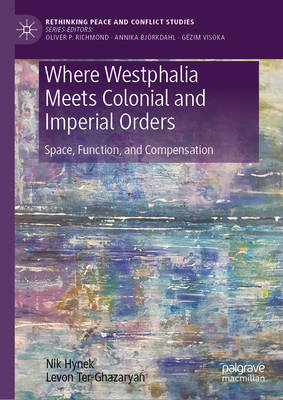
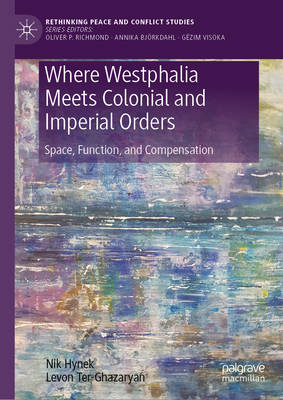
Where Westphalia Meets Colonial and Imperial Orders
Space, Function, and Compensation
Nik Hynek, Levon Ter-Ghazaryan
€ 151,95
+ 303 punten
Omschrijving
This book reveals how sovereign, non-sovereign, and sovereignty-aspiring actors at the edges of the Westphalian system--particularly in post-/settler-colonial spaces and neo-imperial zones rife with conflict--profoundly reshape world politics beyond the usual anarchy-versus-hierarchy debate. By introducing and integrating novel concepts of liminal ecotones (space), adaptation-exaptation complexes (function), and the principle of trans-systemic circulation (compensation), the authors demonstrate how evolving frontier composites in Djibouti, Palestine, and Armenia/Nagorno-Karabakh, along with the diverse agencies operating across these regions, become epicenters of strategic innovation, resilience, and unorthodox authority. This book arises from extensive research on composite characteristics of international political order where the Westphalian system, though systemically-dominant, is one of several contributing systems. While International Relations and Human and Political Geography forms its main disciplinary bedrock, this book also weaves insights from Security Studies, Postcolonial Studies, Post-Soviet Studies, Anthropology, Strategic Studies, Historiography, and Conflict Resolution. Through spatial lens and organization-theory analysis, this book delivers a valuable contribution to International Organization, IR, and Human and Political Geography, both theoretically and empirically, further underpinned by robust primary data (interviews). By combining interdisciplinary breadth with current global concerns, this book also appeals across a wide spectrum of academic fields and beyond. In addition to its topical relevance, this book enhances its practical marketability and scholarly significance by its interdisciplinarity.
Specificaties
Betrokkenen
- Auteur(s):
- Uitgeverij:
Inhoud
- Aantal bladzijden:
- 359
- Taal:
- Engels
- Reeks:
Eigenschappen
- Productcode (EAN):
- 9783032259684
- Verschijningsdatum:
- 13/07/2026
- Uitvoering:
- Hardcover
- Formaat:
- Genaaid
- Afmetingen:
- 148 mm x 210 mm


Alleen bij Standaard Boekhandel
+ 303 punten op je klantenkaart van Standaard Boekhandel
Cadeau

AANGERADEN


Beoordelingen
We publiceren alleen reviews die voldoen aan de voorwaarden voor reviews. Bekijk onze voorwaarden voor reviews.