


- Afhalen na 1 uur in een winkel met voorraad
- Gratis thuislevering in België vanaf € 30
- Ruim aanbod met 7 miljoen producten
- Afhalen na 1 uur in een winkel met voorraad
- Gratis thuislevering in België vanaf € 30
- Ruim aanbod met 7 miljoen producten





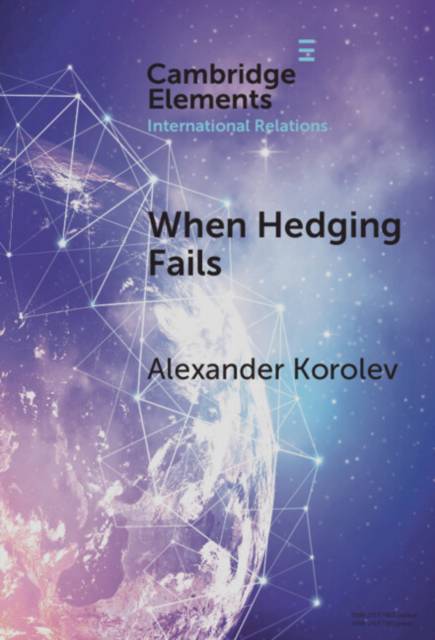
When Hedging Fails
Structural Uncertainty, Protective Options, and Geopolitical (Im)Prudence in Smaller Powers' Behaviour
Alexander Korolev
€ 124,45
+ 248 punten
Uitvoering
Omschrijving
Hedging has been widely viewed as an optimal foreign policy for small and middle powers. However, hedging was more effective in some cases than others and ultimately proved detrimental for certain states. This Element contributes to knowledge about hedging by explaining why some smaller powers can hedge successfully between competing great powers while others fail, suffering serious harm. It develops a theoretical model consisting of international-systemic and state-level variables that determine hedging outcomes. It then tests the model using cases in the post-Soviet space (Georgia, Ukraine) and Southeast Asia (Malaysia, Vietnam, the Philippines) exposed to great power rivalry but exhibiting different hedging outcomes. It shows that hedging failure occurs due to changes in three key variables - structural uncertainty, availability of protective options, and decisionmakers' geopolitical prudence - and interactions between them. The Element highlights the limits to smaller power hedging and argues that hedging should not be taken for granted.
Specificaties
Betrokkenen
- Auteur(s):
- Uitgeverij:
Inhoud
- Aantal bladzijden:
- 72
- Taal:
- Engels
- Reeks:
Eigenschappen
- Productcode (EAN):
- 9781009638081
- Verschijningsdatum:
- 22/01/2026
- Uitvoering:
- Hardcover
- Formaat:
- Genaaid
- Afmetingen:
- 152 mm x 229 mm
- Gewicht:
- 267 g


Alleen bij Standaard Boekhandel
+ 248 punten op je klantenkaart van Standaard Boekhandel
Cadeau

AANGERADEN


Beoordelingen
We publiceren alleen reviews die voldoen aan de voorwaarden voor reviews. Bekijk onze voorwaarden voor reviews.