


- Afhalen na 1 uur in een winkel met voorraad
- Gratis thuislevering in België vanaf € 30
- Ruim aanbod met 7 miljoen producten
- Afhalen na 1 uur in een winkel met voorraad
- Gratis thuislevering in België vanaf € 30
- Ruim aanbod met 7 miljoen producten





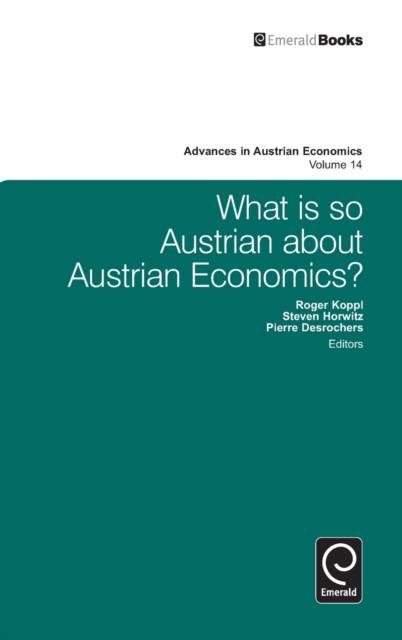
What is so Austrian about Austrian Economics?
€ 267,45
+ 534 punten
Omschrijving
Leading scholars consider Austrian economics from several perspectives such as characteristic themes of entrepreneurship and uncertainty, scientific methods such as mathematical complexity theory and experimental economics, and historical contexts such as pre-war Vienna and post-war France. Placing "Austrian economics" in these multiple contexts helps to reveal the rich texture of the Austrian tradition in social thought and its multiple connections to current research in diverse fields. Applications to the theory of the trade cycle and to foreign intervention suggest that the Austrian tradition contains possibilities not yet full explored and exploited. The volume gathers together papers presented at the second biennial Wirth conference on Austrian economics, held in October 2008 when the crisis of Fall 2008 was still new and shocking. This coincidence of timing makes policy issues and crisis management a kind of leitmotif of the volume. If, as keynote speaker David Colander argues, Austrians have a comparative advantage in political economy, then its stock should rise in times of crisis and political uncertainty. The volume provides evidence in favor of this view. Contributors include David Colander, Richard Wagner, Jeffery McMullen, J. Barkley Rosser, Jr., Steve Horwitz, Richard Ebeling, Chris Coyne, and Peter Boettke.
Specificaties
Betrokkenen
- Uitgeverij:
Inhoud
- Aantal bladzijden:
- 258
- Taal:
- Engels
- Reeks:
- Reeksnummer:
- nr. 14
Eigenschappen
- Productcode (EAN):
- 9780857242617
- Verschijningsdatum:
- 12/08/2010
- Uitvoering:
- Hardcover
- Formaat:
- Ongenaaid / garenloos gebonden
- Afmetingen:
- 152 mm x 231 mm
- Gewicht:
- 498 g

Alleen bij Standaard Boekhandel
+ 534 punten op je klantenkaart van Standaard Boekhandel
Cadeau

AANGERADEN


Beoordelingen
We publiceren alleen reviews die voldoen aan de voorwaarden voor reviews. Bekijk onze voorwaarden voor reviews.