


- Afhalen na 1 uur in een winkel met voorraad
- Gratis thuislevering in België vanaf € 30
- Ruim aanbod met 7 miljoen producten
- Afhalen na 1 uur in een winkel met voorraad
- Gratis thuislevering in België vanaf € 30
- Ruim aanbod met 7 miljoen producten





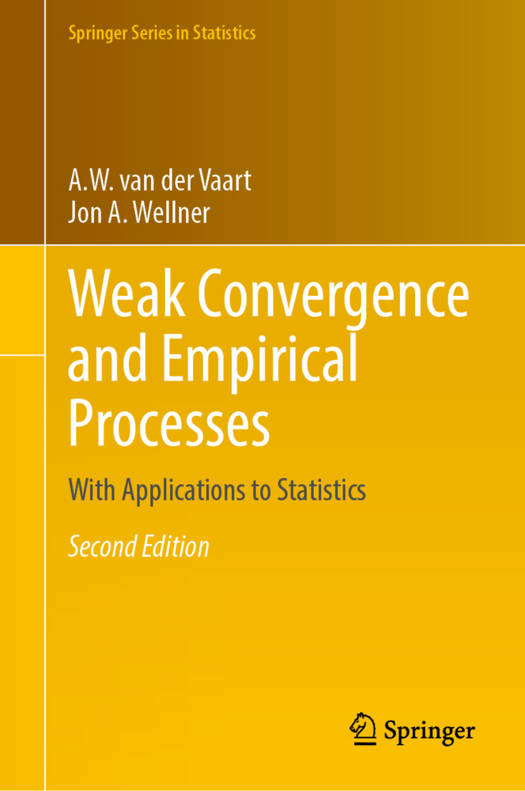
Weak Convergence and Empirical Processes
With Applications to Statistics
A W Van Der Vaart, Jon a Wellner
€ 151,95
+ 303 punten
Omschrijving
This book provides an account of weak convergence theory, empirical processes, and their application to a wide variety of problems in statistics. The first part of the book presents a thorough treatment of stochastic convergence in its various forms. Part 2 brings together the theory of empirical processes in a form accessible to statisticians and probabilists. In Part 3, the authors cover a range of applications in statistics including rates of convergence of estimators; limit theorems for M- and Z-estimators; the bootstrap; the functional delta-method and semiparametric estimation. Most of the chapters conclude with "problems and complements." Some of these are exercises to help the reader's understanding of the material, whereas others are intended to supplement the text.
This second edition includes many of the new developments in the field since publication of the first edition in 1996: Glivenko-Cantelli preservation theorems; new bounds on expectations ofsuprema of empirical processes; new bounds on covering numbers for various function classes; generic chaining; definitive versions of concentration bounds; and new applications in statistics including penalized M-estimation, the lasso, classification, and support vector machines. The approximately 200 additional pages also round out classical subjects, including chapters on weak convergence in Skorokhod space, on stable convergence, and on processes based on pseudo-observations.
This second edition includes many of the new developments in the field since publication of the first edition in 1996: Glivenko-Cantelli preservation theorems; new bounds on expectations ofsuprema of empirical processes; new bounds on covering numbers for various function classes; generic chaining; definitive versions of concentration bounds; and new applications in statistics including penalized M-estimation, the lasso, classification, and support vector machines. The approximately 200 additional pages also round out classical subjects, including chapters on weak convergence in Skorokhod space, on stable convergence, and on processes based on pseudo-observations.
Specificaties
Betrokkenen
- Auteur(s):
- Uitgeverij:
Inhoud
- Aantal bladzijden:
- 679
- Taal:
- Engels
- Reeks:
Eigenschappen
- Productcode (EAN):
- 9783031290381
- Verschijningsdatum:
- 12/07/2023
- Eerder verschenen als:
- Uitvoering:
- Hardcover
- Formaat:
- Genaaid
- Afmetingen:
- 156 mm x 234 mm
- Gewicht:
- 1147 g


Alleen bij Standaard Boekhandel
+ 303 punten op je klantenkaart van Standaard Boekhandel
Cadeau

AANGERADEN


Beoordelingen
We publiceren alleen reviews die voldoen aan de voorwaarden voor reviews. Bekijk onze voorwaarden voor reviews.