


- Afhalen na 1 uur in een winkel met voorraad
- Gratis thuislevering in België vanaf € 30
- Ruim aanbod met 7 miljoen producten
- Afhalen na 1 uur in een winkel met voorraad
- Gratis thuislevering in België vanaf € 30
- Ruim aanbod met 7 miljoen producten





Omschrijving
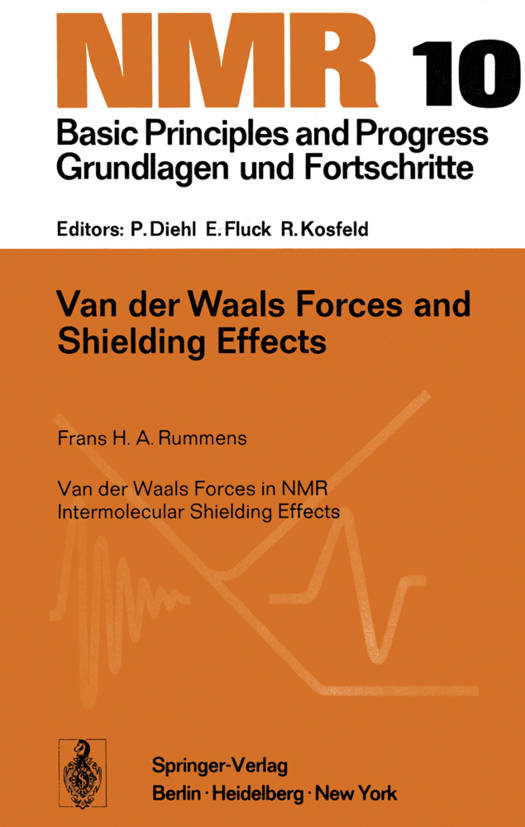
The usefulness of solvent effect studies on NMR chemical shifts need not be elabo- rated here; many applications of solvent effects continue to be published in great profusion. Quite a few intermolecular phenomenae may contribute to solvent shifts, but there is always the ubiquitous Van der Waals effect ow. Contrary to such other effects as neighbour anisotropy 0a, reaction field contribution 0E or complexation effects 0e, no major direct use has yet been found for the Van der Waals effect. So far the role of the Van der Waals effect has been that of a nasty, disturbing phenom- enon, something to be eliminated at all costs. But it is precisely in this latter respect where almost all solvent effect studies fall short. Not only is Ow usually large (larger than 0a and 0E even in 1 H NMR and probably the dominating term with heavier nuclei), but it is strongly variable from one solute to another and even from one nu- clear site to another in the same solute molecule. No referencing technique, however cleverly devised, will be capable of eliminating the Ow contribution from the other, presumedly more interesting contributions. It appeared quite recently that mathematical trickery by the name of "factor analysis" could achieve the sought-for separation of contribuants.
Specificaties
Betrokkenen
- Auteur(s):
- Uitgeverij:
Inhoud
- Aantal bladzijden:
- 122
- Taal:
- Engels
- Reeks:
- Reeksnummer:
- nr. 10
Eigenschappen
- Productcode (EAN):
- 9783642661785
- Verschijningsdatum:
- 9/02/2012
- Uitvoering:
- Paperback
- Formaat:
- Trade paperback (VS)
- Afmetingen:
- 170 mm x 244 mm
- Gewicht:
- 217 g


Alleen bij Standaard Boekhandel
+ 307 punten op je klantenkaart van Standaard Boekhandel
Wedstrijd


Beoordelingen
We publiceren alleen reviews die voldoen aan de voorwaarden voor reviews. Bekijk onze voorwaarden voor reviews.