


- Afhalen na 1 uur in een winkel met voorraad
- Gratis thuislevering in België vanaf € 30
- Ruim aanbod met 7 miljoen producten
- Afhalen na 1 uur in een winkel met voorraad
- Gratis thuislevering in België vanaf € 30
- Ruim aanbod met 7 miljoen producten





Omschrijving
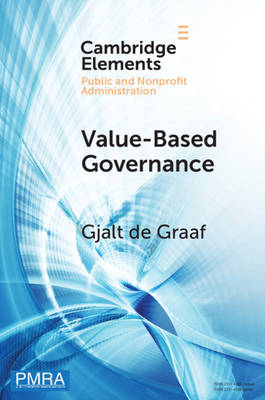
Public governance is inherently normative, so it is important to study the values of public governance - particularly in the present-day context, where, given increasingly differentiated Western public governance, many different values come into play and new value conflicts arise. In this Element, a value-based governance (VBG) perspective is presented. In this perspective, values take center stage as the guiding concept in the theory and practice of public administration and are used as a heuristic to understand and analyze public governance. One section focuses on the advantages and disadvantages of coping strategies used by actors and institutions when dealing with value conflicts. In the final section, the author returns to the practice of public governance: the VBG paradigm entails public governance with normative reasoning. Value-based governance is about bringing the value rationality back in and recognizing intrinsic values. This title is also available as Open Access on Cambridge Core.
Specificaties
Betrokkenen
- Auteur(s):
- Uitgeverij:
Inhoud
- Aantal bladzijden:
- 92
- Taal:
- Engels
- Reeks:
Eigenschappen
- Productcode (EAN):
- 9781009621632
- Verschijningsdatum:
- 22/01/2026
- Uitvoering:
- Paperback
- Formaat:
- Trade paperback (VS)
- Afmetingen:
- 152 mm x 229 mm
- Gewicht:
- 136 g


Alleen bij Standaard Boekhandel
+ 72 punten op je klantenkaart van Standaard Boekhandel
Cadeau

AANGERADEN


Beoordelingen
We publiceren alleen reviews die voldoen aan de voorwaarden voor reviews. Bekijk onze voorwaarden voor reviews.