


- Afhalen na 1 uur in een winkel met voorraad
- Gratis thuislevering in België vanaf € 30
- Ruim aanbod met 7 miljoen producten
- Afhalen na 1 uur in een winkel met voorraad
- Gratis thuislevering in België vanaf € 30
- Ruim aanbod met 7 miljoen producten





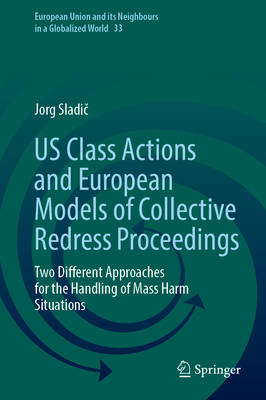
Us Class Actions and European Models of Collective Redress Proceedings
Two Different Approaches for the Handling of Mass Harm Situations
Jorg Sladič
€ 173,45
+ 346 punten
Omschrijving
The book deals in redress for mass harm in modern legal orders on both sides of the Atlantic. The US have created class actions. Europe prefers a mix of public and private tools for redress of mass harm including collective redress or representative actions. Managerial judges, entrepreneurial lawyers, contingency fees, absence of cost shifting rules in the US and notice pleadings are examined. Lack of managerial judging and traditional prohibition of entrepreneurial lawyering in many nations in the EU is discussed. Contingency fees (pacta de quota litis) are not yet generally accepted in the EU collective redress where cost-shifting rules (the loser pays principle) are applied. The fundamentally different approach between the US and Europe suggests that EU collective redress does not have the same significance as the US class action thus making copy-pasting of US experience in class action very questionable.
Specificaties
Betrokkenen
- Auteur(s):
- Uitgeverij:
Inhoud
- Aantal bladzijden:
- 436
- Taal:
- Engels
- Reeks:
- Reeksnummer:
- nr. 33
Eigenschappen
- Productcode (EAN):
- 9783032176493
- Verschijningsdatum:
- 20/02/2026
- Uitvoering:
- Hardcover
- Formaat:
- Genaaid
- Afmetingen:
- 156 mm x 234 mm
- Gewicht:
- 807 g


Alleen bij Standaard Boekhandel
+ 346 punten op je klantenkaart van Standaard Boekhandel
Cadeau

AANGERADEN


Beoordelingen
We publiceren alleen reviews die voldoen aan de voorwaarden voor reviews. Bekijk onze voorwaarden voor reviews.