


- Afhalen na 1 uur in een winkel met voorraad
- Gratis thuislevering in België vanaf € 30
- Ruim aanbod met 7 miljoen producten
- Afhalen na 1 uur in een winkel met voorraad
- Gratis thuislevering in België vanaf € 30
- Ruim aanbod met 7 miljoen producten





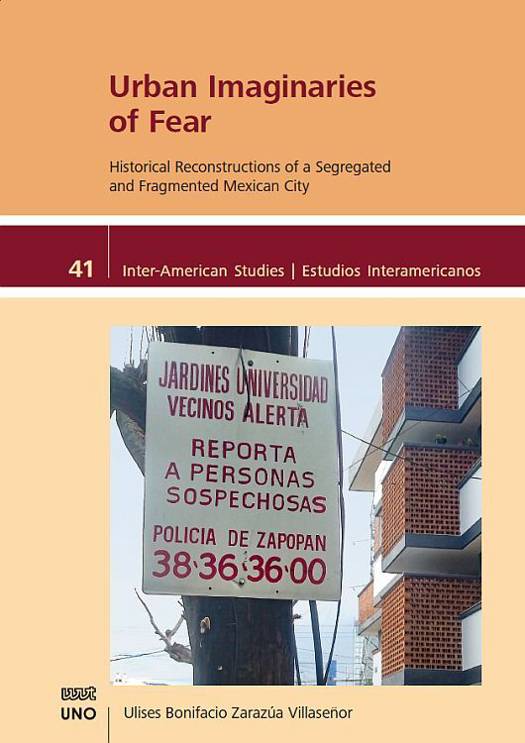
Urban Imaginaries of Fear:
Historical Reconstructions of a Segregated and Fragmented Mexican City
Ulises Bonifacio Zarazúa Villaseñor
€ 34,95
+ 69 punten
Omschrijving
This investigation seeks to understand how urban imaginaries of fear have led to segregation and fragmentation in the Mexican city of Guadalajara. The distinct socio-economic spaces of Santa Cecilia and Puerta de Hierro are explored to understand the social constructions of fear and perceived danger in urban areas.
This study employs a multidisciplinary approach through ethnographic fieldwork, historical reconstruction, archival research, and media content analysis to examine the socio-spatial dynamics that have propagated the urban imaginaries of fear that exist in Guadalajara. It reveals how the historically marginalized Santa Cecilia district has been portrayed as a wild no-go zone full of danger. In turn, Puerta de Hierro's gated community reflects its affluent residents' fears and the trending desire for urban separation, isolation, and fortification.
The research concludes that urban imaginaries of fear have played a significant role in influencing public policy, city planning, urban division, social cohesion, and stereotypes that affect the quality of life for its residents. By combining historical analysis with contemporary media studies and first-hand accounts from residents from both sides of the divide, this investigation provides valuable insights for understanding the intentional processes of urban segregation and how they perpetuate and exacerbate social inequalities.
CONTENTS
Acknowledgements xi
INTRODUCTION 1
Urban imaginaries of fear: spatializing the fear in the city 2
Social constructionism 5
Urban imaginaries as a concept 6
Research questions 11
How to apply the concept to two extreme cases 13
Decomposing the urban imaginaries of fear 14
Political, social, and theoretical relevance 18
1. URBAN HISTORY OF GUADALAJARA 19
Foundation and conquest 19
The Colonial period 19
Independence 23
The Porfiriato period 25
After the Mexican Revolution: Colonia Obrera 30
The urban impact of the ISI model: the Mexican miracle 32
Changing the model of segregation and the arrival of gated communities 34
"Safe" places and "dangerous" districts in local press 36
Yahoo! Answers 37
Santa Cecilia and Puerta de Hierro: two opposite and paradigmatic cases 39
SANTA CECILIA 41
2. BACKGROUNDS: HISTORY AND DESCRIPTION 43
Foundation and history of Santa Cecilia 44
Physical description 48
Characteristics of the inhabitants 54
Local practices and urban dynamics 56
3. METHODOLOGY IN SANTA CECILIA 59
Methodological design for Santa Cecilia 59
Ethnography and urban imaginaries 61
Generalizability 64
Middle class discourse on Santa Cecilia 64
Entering the field: reflexivity 65
4. SANTA CECILIA IN LOCAL PRESS 72
The media eyes on Santa Cecilia 72
Construction of a dangerous place 77
Metanarratives 98
The cases 104
5. SANTA CECILIA: LOCAL DISCOURSE AND SOCIAL PRACTICES 115
Positioning in front of danger 115
Where is the violence? 121
Gender matters: how men and women use the space 127
Troubles outside gangs: tracking symbolic violence 128
The blurred private-public border 131
Police practices 134
Survival handbook: how to avoid becoming a victim 136
PUERTA DE HIERRO 141
6. BACKGROUNDS: HISTORY AND DESCRIPTION 143
Foundation and history of Puerta de Hierro 144
Physical description: topography, houses, and streets 146
Characteristics of inhabitants 150
Lo
This study employs a multidisciplinary approach through ethnographic fieldwork, historical reconstruction, archival research, and media content analysis to examine the socio-spatial dynamics that have propagated the urban imaginaries of fear that exist in Guadalajara. It reveals how the historically marginalized Santa Cecilia district has been portrayed as a wild no-go zone full of danger. In turn, Puerta de Hierro's gated community reflects its affluent residents' fears and the trending desire for urban separation, isolation, and fortification.
The research concludes that urban imaginaries of fear have played a significant role in influencing public policy, city planning, urban division, social cohesion, and stereotypes that affect the quality of life for its residents. By combining historical analysis with contemporary media studies and first-hand accounts from residents from both sides of the divide, this investigation provides valuable insights for understanding the intentional processes of urban segregation and how they perpetuate and exacerbate social inequalities.
CONTENTS
Acknowledgements xi
INTRODUCTION 1
Urban imaginaries of fear: spatializing the fear in the city 2
Social constructionism 5
Urban imaginaries as a concept 6
Research questions 11
How to apply the concept to two extreme cases 13
Decomposing the urban imaginaries of fear 14
Political, social, and theoretical relevance 18
1. URBAN HISTORY OF GUADALAJARA 19
Foundation and conquest 19
The Colonial period 19
Independence 23
The Porfiriato period 25
After the Mexican Revolution: Colonia Obrera 30
The urban impact of the ISI model: the Mexican miracle 32
Changing the model of segregation and the arrival of gated communities 34
"Safe" places and "dangerous" districts in local press 36
Yahoo! Answers 37
Santa Cecilia and Puerta de Hierro: two opposite and paradigmatic cases 39
SANTA CECILIA 41
2. BACKGROUNDS: HISTORY AND DESCRIPTION 43
Foundation and history of Santa Cecilia 44
Physical description 48
Characteristics of the inhabitants 54
Local practices and urban dynamics 56
3. METHODOLOGY IN SANTA CECILIA 59
Methodological design for Santa Cecilia 59
Ethnography and urban imaginaries 61
Generalizability 64
Middle class discourse on Santa Cecilia 64
Entering the field: reflexivity 65
4. SANTA CECILIA IN LOCAL PRESS 72
The media eyes on Santa Cecilia 72
Construction of a dangerous place 77
Metanarratives 98
The cases 104
5. SANTA CECILIA: LOCAL DISCOURSE AND SOCIAL PRACTICES 115
Positioning in front of danger 115
Where is the violence? 121
Gender matters: how men and women use the space 127
Troubles outside gangs: tracking symbolic violence 128
The blurred private-public border 131
Police practices 134
Survival handbook: how to avoid becoming a victim 136
PUERTA DE HIERRO 141
6. BACKGROUNDS: HISTORY AND DESCRIPTION 143
Foundation and history of Puerta de Hierro 144
Physical description: topography, houses, and streets 146
Characteristics of inhabitants 150
Lo
Specificaties
Betrokkenen
- Auteur(s):
- Uitgeverij:
Inhoud
- Taal:
- Engels
- Reeks:
- Reeksnummer:
- nr. 41
Eigenschappen
- Productcode (EAN):
- 9783989400450
- Verschijningsdatum:
- 31/01/2025
- Uitvoering:
- Paperback
- Afmetingen:
- 140 mm x 30 mm
- Gewicht:
- 368 g


Alleen bij Standaard Boekhandel
+ 69 punten op je klantenkaart van Standaard Boekhandel
Cadeau

AANGERADEN


Beoordelingen
We publiceren alleen reviews die voldoen aan de voorwaarden voor reviews. Bekijk onze voorwaarden voor reviews.