


- Afhalen na 1 uur in een winkel met voorraad
- Gratis thuislevering in België vanaf € 30
- Ruim aanbod met 7 miljoen producten
- Afhalen na 1 uur in een winkel met voorraad
- Gratis thuislevering in België vanaf € 30
- Ruim aanbod met 7 miljoen producten





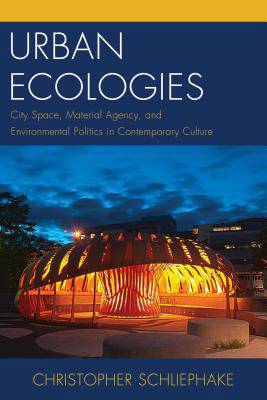
Urban Ecologies
City Space, Material Agency, and Environmental Politics in Contemporary Culture
Christopher Schliephake
€ 103,45
+ 206 punten
Uitvoering
Omschrijving
The term "urban ecology" has become a buzzword in various disciplines, including the social and natural sciences as well as urban planning and architecture. The environmental humanities have been slow to adapt to current theoretical debates, often excluding human-built environments from their respective frameworks. This book closes this gap both in theory and in practice, bringing together "urban ecology" with ecocritical and cultural ecological approaches by conceptualizing the city as an integral part of the environment and as a space in which ecological problems manifest concretely. Arguing that culture has to be seen as an active component and integral factor within urban ecologies, it makes use of a metaphorical use of the term, perceiving cities as spatial phenomena that do not only have manifold and complex material interrelations with their respective (natural) environments, but that are intrinsically connected to the ideas, imaginations, and interpretations that make up the cultural symbolic and discursive side of our urban lives and that are stored and constantly renegotiated in their cultural and artistic representations. The city is, within this framework, both seen as an ecosystemically organized space as well as a cultural artifact. Thus, the urban ecology outlined in this study takes its main impetus from an analysis of examples taken from contemporary culture that deal with urban life and the complex interrelations between urban communities and their (natural and built) environments.
Specificaties
Betrokkenen
- Auteur(s):
- Uitgeverij:
Inhoud
- Aantal bladzijden:
- 268
- Taal:
- Engels
- Reeks:
Eigenschappen
- Productcode (EAN):
- 9780739195772
- Verschijningsdatum:
- 27/03/2017
- Uitvoering:
- Paperback
- Formaat:
- Trade paperback (VS)
- Afmetingen:
- 152 mm x 229 mm
- Gewicht:
- 394 g


Alleen bij Standaard Boekhandel
+ 206 punten op je klantenkaart van Standaard Boekhandel
Cadeau

AANGERADEN


Beoordelingen
We publiceren alleen reviews die voldoen aan de voorwaarden voor reviews. Bekijk onze voorwaarden voor reviews.