


- Afhalen na 1 uur in een winkel met voorraad
- Gratis thuislevering in België vanaf € 30
- Ruim aanbod met 7 miljoen producten
- Afhalen na 1 uur in een winkel met voorraad
- Gratis thuislevering in België vanaf € 30
- Ruim aanbod met 7 miljoen producten





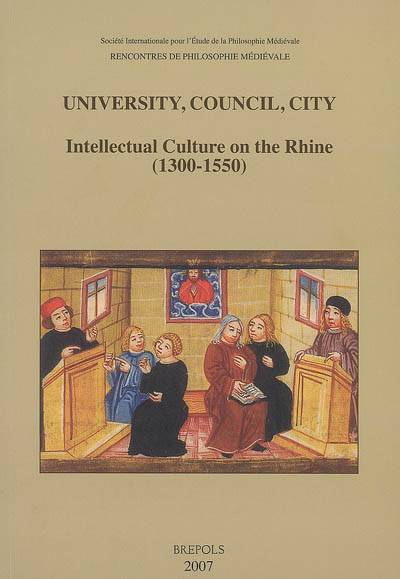
University, council, city
intellectual culture on the Rhine (1300-1550)
Rencontres de philosophie médiévale (01 ; 1989 ; Cassino, Italie
€ 31,80
+ 63 punten
Omschrijving
Stretching from Basel to Cologne, the Rhine formed the geographical
axis of a broad cultural realm in the late Middle Ages, lending vitality not
only to its cities and universities but also to the two great Councils to which
it played host. Already in the fourteenth century, the lives of such famous
German mystics as Meister Eckhart, Heinrich Seuse and Johannes Tauler
testify to the presence of an advanced intellectual culture in the cities of
the upper and lower Rhine. In the fifteenth century, the most famous Councils
of the late Middle Ages took place along the Rhine, namely the Councils
of Constance and Basel, which formed loci of intellectual exchange
and which became seedbeds of philosophical ideas that engaged and influenced
such participants as Heymericus de Campo and Nicholas of Cusa.
With the establishment of the Universities of Cologne (1388), Freiburg
(1457), Basel (1459) and Mainz (1476), the intellectual culture of this region
took an institutional form that continues to exist to this day, and symbolizes
the stability of the intellectual culture of the Rhineland. The main
purpose of this volume is to explore the intellectual richness and vitality
of the Rhineland in its various facets and on its different levels.
Specificaties
Betrokkenen
- Auteur(s):
- Uitgeverij:
Inhoud
- Aantal bladzijden:
- 366
- Taal:
- Frans
- Reeks:
- Reeksnummer:
- nr. 13
Eigenschappen
- Productcode (EAN):
- 9782503526638
- Verschijningsdatum:
- 1/10/2007
- Uitvoering:
- Paperback
- Formaat:
- Trade paperback (VS)
- Afmetingen:
- 170 mm x 240 mm
- Gewicht:
- 765 g


Alleen bij Standaard Boekhandel
+ 63 punten op je klantenkaart van Standaard Boekhandel
Cadeau

AANGERADEN


Beoordelingen
We publiceren alleen reviews die voldoen aan de voorwaarden voor reviews. Bekijk onze voorwaarden voor reviews.