


- Afhalen na 1 uur in een winkel met voorraad
- Gratis thuislevering in België vanaf € 30
- Ruim aanbod met 7 miljoen producten
- Afhalen na 1 uur in een winkel met voorraad
- Gratis thuislevering in België vanaf € 30
- Ruim aanbod met 7 miljoen producten





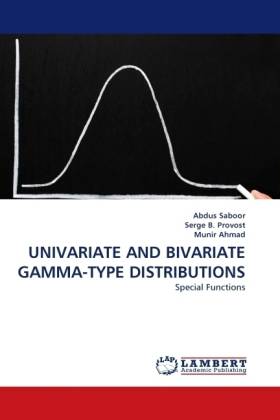
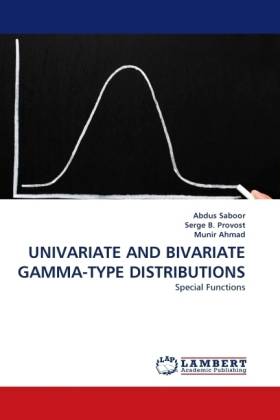
UNIVARIATE AND BIVARIATE GAMMA-TYPE DISTRIBUTIONS
Special Functions
Abdus Saboor, Serge B. Provost, Munir Ahmad
Paperback | Engels
€ 48,45
+ 96 punten
Omschrijving
In this book we define univariate and bivariate gamma-type distributions and discuss some of their statistical functions, including the moment generating function. Numerous distributions such as the Rayleigh, half-normal and Maxwell distributions can be obtained as special cases. The moment generating function of both univariate and bivariate random variables are derived by making use of the inverse Mellin transform technique and expressed in terms of generalized hypergeometric functions. These representations provide computable expressions for the moment generating functions of several of the distributions that were identified as particular cases. Some other statistical functions are also given in closed form. The univariate distribution is utilized to model two data sets. This model provides a better fit than the two-parameter Weibull model or its shifted counterpart, as measured by the Anderson-Darling and Cramer-von Mises statistics.
Specificaties
Betrokkenen
- Auteur(s):
- Uitgeverij:
Inhoud
- Aantal bladzijden:
- 80
- Taal:
- Engels
Eigenschappen
- Productcode (EAN):
- 9783838345536
- Verschijningsdatum:
- 26/06/2010
- Uitvoering:
- Paperback
- Afmetingen:
- 152 mm x 229 mm
- Gewicht:
- 127 g


Alleen bij Standaard Boekhandel
+ 96 punten op je klantenkaart van Standaard Boekhandel
Cadeau

AANGERADEN


Beoordelingen
We publiceren alleen reviews die voldoen aan de voorwaarden voor reviews. Bekijk onze voorwaarden voor reviews.