


Bedankt voor het vertrouwen het afgelopen jaar! Om jou te bedanken bieden we GRATIS verzending (in België) aan op alles gedurende de hele maand januari.
- Afhalen na 1 uur in een winkel met voorraad
- In januari gratis thuislevering in België
- Ruim aanbod met 7 miljoen producten
Bedankt voor het vertrouwen het afgelopen jaar! Om jou te bedanken bieden we GRATIS verzending (in België) aan op alles gedurende de hele maand januari.
- Afhalen na 1 uur in een winkel met voorraad
- In januari gratis thuislevering in België
- Ruim aanbod met 7 miljoen producten





Omschrijving
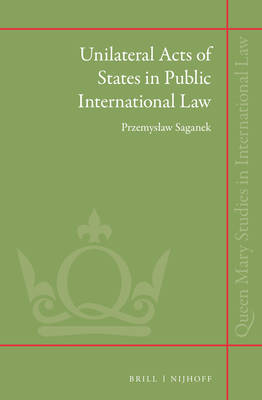
In Unilateral Acts of States in Public International Law Przemyslaw Saganek discusses one of the most important sources of States' obligations in international law.
He analyzes in a critical way the classical catalogue of unilateral acts comprising: promise, waiver, recognition and protest. He convincingly proves that this list is misleading as it oversees several important acts of States. On the other hand, several classical acts do not necessarily give rise to legal effects or are not necessarily unilateral. The author undertakes a thorough analysis of several types of acts, showing their similarities and dissimilarities. He concludes that the group category of 'unilateral acts' covers such diverse elements that they could be hardly codified in a single set of rules.
He analyzes in a critical way the classical catalogue of unilateral acts comprising: promise, waiver, recognition and protest. He convincingly proves that this list is misleading as it oversees several important acts of States. On the other hand, several classical acts do not necessarily give rise to legal effects or are not necessarily unilateral. The author undertakes a thorough analysis of several types of acts, showing their similarities and dissimilarities. He concludes that the group category of 'unilateral acts' covers such diverse elements that they could be hardly codified in a single set of rules.
Specificaties
Betrokkenen
- Auteur(s):
- Uitgeverij:
Inhoud
- Aantal bladzijden:
- 670
- Taal:
- Engels
- Reeks:
- Reeksnummer:
- nr. 22
Eigenschappen
- Productcode (EAN):
- 9789004274600
- Verschijningsdatum:
- 20/11/2015
- Uitvoering:
- Hardcover
- Formaat:
- Genaaid
- Afmetingen:
- 157 mm x 239 mm
- Gewicht:
- 1043 g


Alleen bij Standaard Boekhandel
+ 490 punten op je klantenkaart van Standaard Boekhandel
SOLDEN


Beoordelingen
We publiceren alleen reviews die voldoen aan de voorwaarden voor reviews. Bekijk onze voorwaarden voor reviews.