


- Afhalen na 1 uur in een winkel met voorraad
- Gratis thuislevering in België vanaf € 30
- Ruim aanbod met 7 miljoen producten
- Afhalen na 1 uur in een winkel met voorraad
- Gratis thuislevering in België vanaf € 30
- Ruim aanbod met 7 miljoen producten




€ 1,99
+ 1 punten
Omschrijving
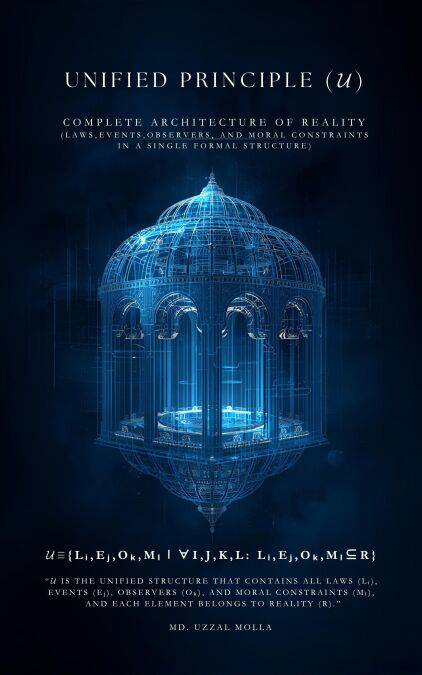
Unified Principle (𝓤): Complete Architecture of Reality
This thesis proposes an integrated and mathematically rigorous framework for understanding reality, in which laws, events, observers, and moral constraints are unified within a single coherent structure, denoted by 𝓤. Although conventional science has been highly successful in predicting phenomena, it suffers from a fragmented structure of knowledge-physical laws, quantum indeterminacy, consciousness, and morality are often treated separately. This separation creates conceptual incompleteness and hinders the formation of a logically consistent, observer-integrated model of reality.
𝓤 is formally defined as follows:
𝓤 ≡ {Lᵢ,Eⱼ,Oₖ,Mₗ∣∀i,j,k,l: Lᵢ,Eⱼ,Oₖ,Mₗ ⊆R}
"𝓤 is the unified structure that contains all laws (Lᵢ), events (Eⱼ), observers (Oₖ), and moral constraints (Mₗ), and each element belongs to reality (R)."
The Unified Principle (𝓤) constitutes the first fully integrated, mathematically and philosophically complete framework for reality. It unifies science, morality, consciousness, and civilization within a single coherent model, ensuring that human knowledge, action, and social development remain fully aligned with the fundamental architecture of reality. This work redefines the boundaries of science, philosophy, and ethics, and provides a unified foundation for future human inquiry and civilization.
Moral Layer: Moral Function as Meta-Constraint
Morality here is not a separate emotion or social contract;
it is a meta-rule imposed upon function-space:
Mₗ(f(Oₖ,Lᵢ))⇒Eⱼ∗∈Eⱼ
• f(Oₖ,Lᵢ) → possible event
• Mₗ → structural filter
• Result → Eⱼ∗
• Eⱼ∗ := the structurally admissible realization of Eⱼ
Where Eⱼ∗ ∈ Eⱼ is the structurally admissible outcome.
A valid, structurally permitted event
that is consistent with both laws (Lᵢ) and moral constraints (Mₗ)
Philosophical Implications
Reality as Totality: Everything is within 𝓤; nothing exists outside it.
Non-reducibility: L,E,O,M are ontologically fundamental; removing or reducing them generates paradox.
Observer Responsibility:
Every observational act is embedded within reality; no act is morally or physically neutral.
Moral Realism: Morality emerges from structural necessity rather than theological doctrine or personal preference.
Completeness: 𝓤 is capable of generating all events, scientific laws, moral principles, and civilizational constraints.
Essence: 𝓤 unifies science, morality, and consciousness into a single mathematical-philosophical architecture, providing a logically necessary structure for understanding reality.
Mathematical Formalism of Reality-Observer Interaction
Event Functional
No event in reality is spontaneous; it is the joint result of laws, observers, and moral structure.
Eⱼ = f(Lᵢ,Oₖ,Mₗ)
Explanation:
Lᵢ – the legal structure permitting the event
Oₖ – the observer activating and registering the event
Mₗ – the structural moral boundary of the event
Information-Theoretic Mapping
Each event is registered in reality as information, but not randomly.
I(Eⱼ) = entropy-consistent, observer-registered, law-aligned data
Meaning:
Information must be entropy-consistent
Registered by an observer
And consistent with the applicable laws Lᵢ
Thus information, time, and reality are unified within the same structure.
Necessity of Transcendence:
The logical inference of a Creator / Ground of Reality resolves infinite regress and the problem of the origin of laws.
∴ ∃G : G = Ground of Reality
Philosophical Meaning:
This G – Creator / Ultimate Ground – is not a religious assumption, but a mathematical and logical necessity.
Specificaties
Betrokkenen
- Auteur(s):
- Uitgeverij:
Inhoud
- Taal:
- Engels
Eigenschappen
- Productcode (EAN):
- 9798232471545
- Verschijningsdatum:
- 13/03/2026
- Uitvoering:
- E-book
- Formaat:
- ePub


Alleen bij Standaard Boekhandel
+ 1 punten op je klantenkaart van Standaard Boekhandel
AANGERADEN


Beoordelingen
We publiceren alleen reviews die voldoen aan de voorwaarden voor reviews. Bekijk onze voorwaarden voor reviews.