


- Afhalen na 1 uur in een winkel met voorraad
- Gratis thuislevering in België vanaf € 30
- Ruim aanbod met 7 miljoen producten
- Afhalen na 1 uur in een winkel met voorraad
- Gratis thuislevering in België vanaf € 30
- Ruim aanbod met 7 miljoen producten





€ 61,45
+ 122 punten
Omschrijving
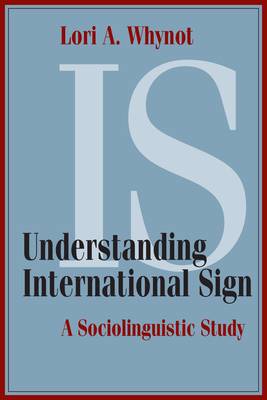
In Understanding International Sign, Lori A. Whynot examines International Sign (IS) to determine the extent to which signers from different countries comprehend it. She focuses exclusively on expository lecture IS used in conference settings and presents the first empirical research on its effectiveness for communicating rich information to diverse audience members.
International Sign is regarded as a lingua franca that is employed by deaf people to communicate with other deaf people who do not share the same conventionalized local sign language. Contrary to widely-held belief, sign languages are not composed of a unified system of universal gestures--rather, they are distinctly different, and most are mutually unintelligible from one another. The phenomenon of IS has emerged through increased global interaction during recent decades, driven by a rise in the number of international conferences and events and by new technologies that allow for enhanced global communication. IS is gaining acceptance for providing communicative access to conference audience members who do not have knowledge of the designated conference languages, and it is being recruited for use due to the prohibitive expense of providing interpreting services in numerous different sign languages. However, it is not known how well audience members understand IS, and it may actually limit equal access to the interpreted information.
Whynot compares IS to native sign languages and analyzes the distribution of linguistic elements in the IS lexicon and their combined effect on comprehension. Her findings indicate that audiences with diverse sign languages understand much less of IS presentations than has been previously assumed. Whynot's research has crucial implications for expository IS usage, training, and interpreting, and it sheds light on the strengths and weaknesses inherent in cross-linguistic, signed contact settings.
International Sign is regarded as a lingua franca that is employed by deaf people to communicate with other deaf people who do not share the same conventionalized local sign language. Contrary to widely-held belief, sign languages are not composed of a unified system of universal gestures--rather, they are distinctly different, and most are mutually unintelligible from one another. The phenomenon of IS has emerged through increased global interaction during recent decades, driven by a rise in the number of international conferences and events and by new technologies that allow for enhanced global communication. IS is gaining acceptance for providing communicative access to conference audience members who do not have knowledge of the designated conference languages, and it is being recruited for use due to the prohibitive expense of providing interpreting services in numerous different sign languages. However, it is not known how well audience members understand IS, and it may actually limit equal access to the interpreted information.
Whynot compares IS to native sign languages and analyzes the distribution of linguistic elements in the IS lexicon and their combined effect on comprehension. Her findings indicate that audiences with diverse sign languages understand much less of IS presentations than has been previously assumed. Whynot's research has crucial implications for expository IS usage, training, and interpreting, and it sheds light on the strengths and weaknesses inherent in cross-linguistic, signed contact settings.
Specificaties
Betrokkenen
- Auteur(s):
- Uitgeverij:
Inhoud
- Aantal bladzijden:
- 376
- Taal:
- Engels
- Reeks:
Eigenschappen
- Productcode (EAN):
- 9781563686726
- Verschijningsdatum:
- 31/01/2017
- Uitvoering:
- Hardcover
- Formaat:
- Genaaid
- Afmetingen:
- 155 mm x 231 mm
- Gewicht:
- 721 g


Alleen bij Standaard Boekhandel
+ 122 punten op je klantenkaart van Standaard Boekhandel
Cadeau

AANGERADEN


Beoordelingen
We publiceren alleen reviews die voldoen aan de voorwaarden voor reviews. Bekijk onze voorwaarden voor reviews.