


- Afhalen na 1 uur in een winkel met voorraad
- Gratis thuislevering in België vanaf € 30
- Ruim aanbod met 7 miljoen producten
- Afhalen na 1 uur in een winkel met voorraad
- Gratis thuislevering in België vanaf € 30
- Ruim aanbod met 7 miljoen producten





€ 32,95
+ 65 punten
Omschrijving
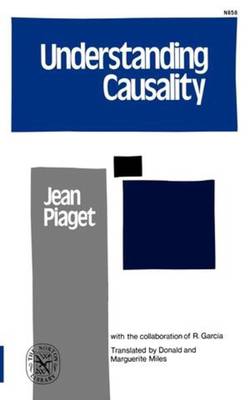
During the past few years, the research of the International Center for Genetic Epistemology has dealt with causality, in its broadest sense, including every explanation of a material phenomenon, both the physical aspects of actions and their relationships to objects. The stages in the development of the understanding of causality pose much more difficult problems than the study of operations of the subjects. Because operations essentially show the general coordinations of the action, the stages of their formulation conform to an inner logic that analysis sooner or later succeeds in drawing out, and that is found again with rather striking regularity in the most diverse fields. Explaining a physical phenomenon must presume the use of such operations because the search for causality always ends up in going beyond the observable and in having recourse to inferred, therefore operational connections. But, in addition, there are the responses of the object, which are of critical importance, because to talk of causality is to presume that objects exist outside of us and that they act independently of us. If the causal model adopted includes an inferential part, the explanation of the phenomenon has the sole purpose of identifying the properties of the object. These properties can resist as well as yield to the subject's operational treatment, resulting in the development of explanations that do not necessarily present the same regularity nor the same relative simplicity as that of logico-mathematical operations.
Specificaties
Betrokkenen
- Auteur(s):
- Vertaler(s):
- Uitgeverij:
Inhoud
- Aantal bladzijden:
- 208
- Taal:
- Engels
Eigenschappen
- Productcode (EAN):
- 9780393008586
- Verschijningsdatum:
- 1/10/1977
- Uitvoering:
- Paperback
- Formaat:
- Trade paperback (VS)
- Afmetingen:
- 127 mm x 203 mm
- Gewicht:
- 231 g


Alleen bij Standaard Boekhandel
+ 65 punten op je klantenkaart van Standaard Boekhandel
Cadeau

AANGERADEN


Beoordelingen
We publiceren alleen reviews die voldoen aan de voorwaarden voor reviews. Bekijk onze voorwaarden voor reviews.