



Bedankt voor het vertrouwen het afgelopen jaar! Om jou te bedanken bieden we GRATIS verzending (in België) aan op alles gedurende de hele maand januari.
- Afhalen na 1 uur in een winkel met voorraad
- In januari gratis thuislevering in België
- Ruim aanbod met 7 miljoen producten
Bedankt voor het vertrouwen het afgelopen jaar! Om jou te bedanken bieden we GRATIS verzending (in België) aan op alles gedurende de hele maand januari.
- Afhalen na 1 uur in een winkel met voorraad
- In januari gratis thuislevering in België
- Ruim aanbod met 7 miljoen producten





Omschrijving
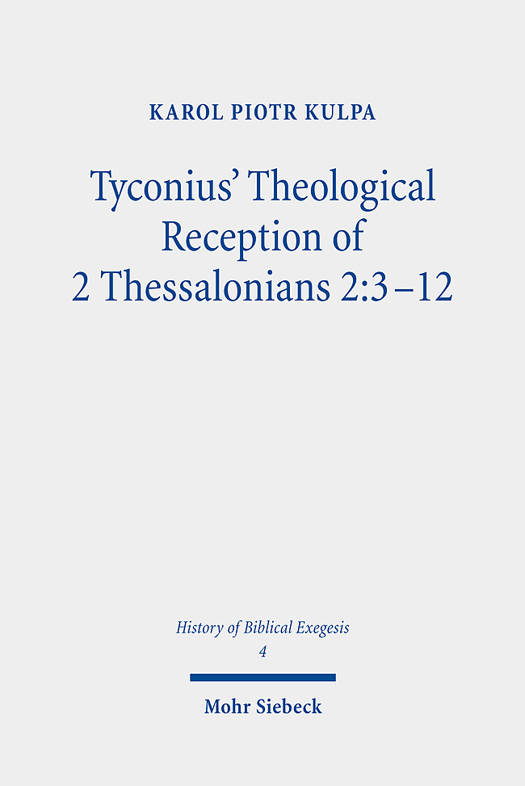
In this volume, Karol Piotr Kulpa offers a coherent analysis of the reception of 2 Thess. 2:3-12 by Tyconius in his Liber Regularum and his reconstructed Expositio Apocalypseos. The author proposes and applies his own method for a reception history composed of historical, literary, and theological levels, which is constructive as well as analytical. In this way he writes a history of reception that not only finds its anchor in the past, but also builds bridges to theological questions of the present. In particular, the author identifies that motifs of homo peccati, mysterium facinoris, and discessio drawn from 2 Thess. 2:3 and 2:7 become Tyconius' "world-constructing verses" in his understanding of Scripture, and of the bipartition in the church's reality, in human nature, and in eschatological temporality. As a result, he offers a refreshingly 'ecumenical' reading of Tyconius, refusing to reduce his significance to that of a 'heretical voice' but re-envisaging him as a potentially authoritative theologian and exegete.
Specificaties
Betrokkenen
- Auteur(s):
- Uitgeverij:
Inhoud
- Aantal bladzijden:
- 338
- Taal:
- Engels
- Reeks:
- Reeksnummer:
- nr. 4
Eigenschappen
- Productcode (EAN):
- 9783161610240
- Verschijningsdatum:
- 1/09/2022
- Uitvoering:
- Paperback
- Formaat:
- Trade paperback (VS)
- Afmetingen:
- 231 mm x 155 mm
- Gewicht:
- 3755 g


Alleen bij Standaard Boekhandel
+ 287 punten op je klantenkaart van Standaard Boekhandel
SOLDEN


Beoordelingen
We publiceren alleen reviews die voldoen aan de voorwaarden voor reviews. Bekijk onze voorwaarden voor reviews.