



Je cadeautjes zeker op tijd in huis hebben voor de feestdagen? Kom langs in onze winkels en vind het perfecte geschenk!
- Afhalen na 1 uur in een winkel met voorraad
- Gratis thuislevering in België vanaf € 30
- Ruim aanbod met 7 miljoen producten
Je cadeautjes zeker op tijd in huis hebben voor de feestdagen? Kom langs in onze winkels en vind het perfecte geschenk!
- Afhalen na 1 uur in een winkel met voorraad
- Gratis thuislevering in België vanaf € 30
- Ruim aanbod met 7 miljoen producten





Omschrijving
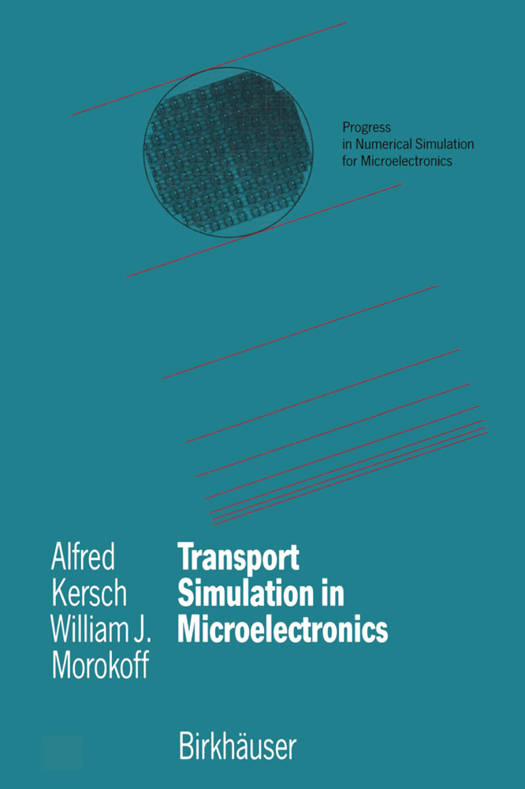
Computer simulation of semiconductor processing equipment and devices requires the use of a wide variety of numerical methods. Of these methods, the Monte Carlo approach is perhaps most fundamentally suited to mod- eling physical events occurring on microscopic scales which are intricately connected to the particle structure of nature. Here physical phenomena can be simulated by following simulation particles (such as electrons, molecules, photons, etc. ) through a statistical sampling of scattering events. Monte Carlo is, however, generally looked on as a last resort due to the extremely slow convergence of these methods. It is of interest, then, to examine when in microelectronics it is necessary to use Monte Carlo methods, how such methods may be improved, and what are the alternatives. This book ad- dresses three general areas of simulation which frequently arise in semicon- ductor modeling where Monte Carlo methods playa significant role. In the first chapter the basic mathematical theory of the Boltzmann equation for particle transport is presented. The following chapters are devoted to the modeling of the transport processes and the associated Monte Carlo meth- ods. Specific examples of industrial applications illustrate the effectiveness and importance of these methods. Two of these areas concern simulation of physical particles which may be assigned a time dependent position and velocity. This includes the molecules of a dilute gas used in such processing equipment as chemi- cal vapor decomposition reactors and sputtering reactors. We also consider charged particles moving within a semiconductor lattice.
Specificaties
Betrokkenen
- Auteur(s):
- Uitgeverij:
Inhoud
- Aantal bladzijden:
- 240
- Taal:
- Engels
- Reeks:
- Reeksnummer:
- nr. 3
Eigenschappen
- Productcode (EAN):
- 9783034898980
- Verschijningsdatum:
- 28/09/2011
- Uitvoering:
- Paperback
- Formaat:
- Trade paperback (VS)
- Afmetingen:
- 152 mm x 229 mm
- Gewicht:
- 335 g


Alleen bij Standaard Boekhandel
+ 152 punten op je klantenkaart van Standaard Boekhandel
CADEAU


Beoordelingen
We publiceren alleen reviews die voldoen aan de voorwaarden voor reviews. Bekijk onze voorwaarden voor reviews.