


- Afhalen na 1 uur in een winkel met voorraad
- Gratis thuislevering in België vanaf € 30
- Ruim aanbod met 7 miljoen producten
- Afhalen na 1 uur in een winkel met voorraad
- Gratis thuislevering in België vanaf € 30
- Ruim aanbod met 7 miljoen producten





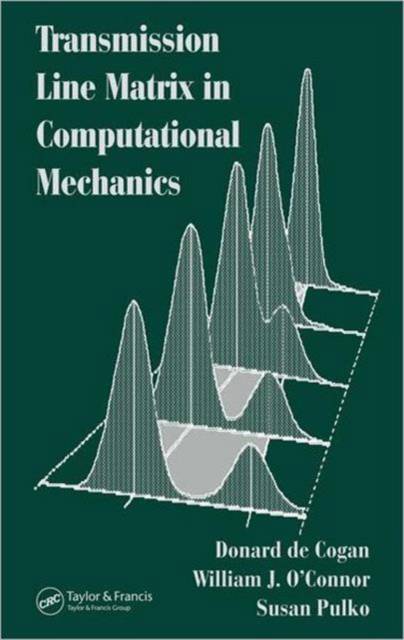
Transmission Line Matrix (Tlm) in Computational Mechanics
Donard de Cogan, William J O'Connor, Susan Pulko
Hardcover | Engels
€ 195,95
+ 391 punten
Omschrijving
The finite element method reigns as the dominant technique for modeling mechanical systems. Originally developed to model electromagnetic systems, the Transmission Line Matrix (TLM) method proves to match, and in some cases exceed, the effectiveness of finite elements for modeling several types of physical systems. Transmission Line Matrix in Computational Mechanics provides a tutorial approach to applying TLM for modeling mechanical and other physical systems. Transmission Line Matrix in Computational Mechanics begins with the history of TLM, an introduction to the theory using mechanical engineering concepts, and the electromagnetic basics of TLM. The authors then demonstrate the theory for use in acoustic propagation, along with examples of MATLAB(R) code. The remainder of the book explores the application of TLM to problems in mechanics, specifically heat and mass transfer, elastic solids, simple deformation models, hydraulic systems, and computational fluid dynamics. A discussion of state-of-the-art techniques concludes the book, offering a look at the current research undertaken by the authors and other leading experts to overcome the limitations of TLM in applying the method to diverse types of systems. This valuable reference introduces students, engineers, and researchers to a powerful, accurate, and stable alternative to finite elements, providing case studies and examples to reinforce the concepts and illustrate the applications.
Specificaties
Betrokkenen
- Auteur(s):
- Uitgeverij:
Inhoud
- Aantal bladzijden:
- 272
- Taal:
- Engels
Eigenschappen
- Productcode (EAN):
- 9780415327176
- Verschijningsdatum:
- 1/10/2005
- Uitvoering:
- Hardcover
- Formaat:
- Genaaid
- Afmetingen:
- 156 mm x 243 mm
- Gewicht:
- 535 g


Alleen bij Standaard Boekhandel
+ 391 punten op je klantenkaart van Standaard Boekhandel
Cadeau

AANGERADEN


Beoordelingen
We publiceren alleen reviews die voldoen aan de voorwaarden voor reviews. Bekijk onze voorwaarden voor reviews.