


- Afhalen na 1 uur in een winkel met voorraad
- Gratis thuislevering in België vanaf € 30
- Ruim aanbod met 7 miljoen producten
- Afhalen na 1 uur in een winkel met voorraad
- Gratis thuislevering in België vanaf € 30
- Ruim aanbod met 7 miljoen producten





€ 201,95
+ 403 punten
Omschrijving
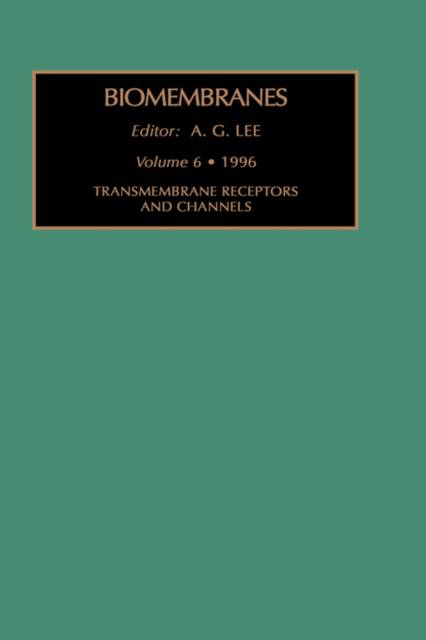
Volume 6 of Biomembranes covers transmembrane receptors and channels. A particularly important role for the membrane is that of passing messages between a cell and its environment. Part I of this volume covers receptors for hormones and growth factors. Here, as in so many other areas of cell biology, the application of the methods of molecular biology have led to the recognition of a number of families of receptors. Typically, such receptors contain an extracellular ligand binding domain, a transmembrane domain, and an intracellular catalytic domain whose activation, as a result of ligand binding, leads to generation of second messengers within the cell and stimulation of a range of cytosolic enzymes. An alternative signaling strategy, exploited in particular in the nervous system, is to use ion channels to allow controlled movement of monovalent (Na+, K+) or divalent (Ca2+) cations in or out of the cell, resulting in changes in membrane potential or alterations in the intracellular concentration of Ca2+. Part II of this volume is concerned with these ion channels and with other, often simpler, ion channel systems whose study can throw light on channel mechanism.
Specificaties
Betrokkenen
- Auteur(s):
- Uitgeverij:
Inhoud
- Aantal bladzijden:
- 420
- Taal:
- Engels
- Reeks:
- Reeksnummer:
- nr. 6
Eigenschappen
- Productcode (EAN):
- 9781559386630
- Verschijningsdatum:
- 26/10/1997
- Uitvoering:
- Hardcover
- Formaat:
- Genaaid
- Afmetingen:
- 156 mm x 234 mm
- Gewicht:
- 784 g


Alleen bij Standaard Boekhandel
+ 403 punten op je klantenkaart van Standaard Boekhandel
Cadeau

AANGERADEN


Beoordelingen
We publiceren alleen reviews die voldoen aan de voorwaarden voor reviews. Bekijk onze voorwaarden voor reviews.