


- Afhalen na 1 uur in een winkel met voorraad
- Gratis thuislevering in België vanaf € 30
- Ruim aanbod met 7 miljoen producten
- Afhalen na 1 uur in een winkel met voorraad
- Gratis thuislevering in België vanaf € 30
- Ruim aanbod met 7 miljoen producten





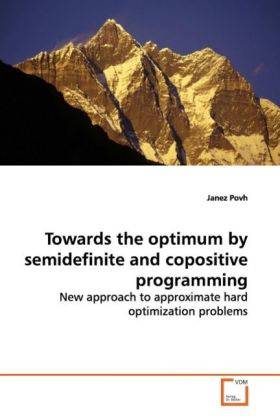
Towards the optimum by semidefinite and copositive programming
New approach to approximate hard optimization problems
Janez Povh
Paperback | Engels
€ 58,45
+ 116 punten
Omschrijving
Semidefinite and copositive programming have attained an
important role in combinatorial optimization in the
last two decades.
There is a strong evidence that semidefinite and
copositive
approximation models are significantly stronger than
the purely
linear ones for many combinatorial problems. In some
cases the
copositive models give even the exact value of the
problem.
The first part of the book contains beside a survey of
standard results from linear algebra and conic
programming also a new
method to solve semidefinite programs, based on the
augmented
Lagrangian method. This method named the Boundary
point method
goes far beyond the reach of interior point methods
when the linear
constraints are nearly orthogonal.
The second part demonstrates the application of
semidefinite and
copositive programming to the following NP-hard
problems from
combinatorial optimization: the bandwidth problem,
the quadratic
assignment problem, the min-cut problem and the
general graph
partitioning problem. The book also provides the
ideas how to extend the approach
to some other 0-1 problems, like the
stability number problem and the balanced vertex
separator problem.
important role in combinatorial optimization in the
last two decades.
There is a strong evidence that semidefinite and
copositive
approximation models are significantly stronger than
the purely
linear ones for many combinatorial problems. In some
cases the
copositive models give even the exact value of the
problem.
The first part of the book contains beside a survey of
standard results from linear algebra and conic
programming also a new
method to solve semidefinite programs, based on the
augmented
Lagrangian method. This method named the Boundary
point method
goes far beyond the reach of interior point methods
when the linear
constraints are nearly orthogonal.
The second part demonstrates the application of
semidefinite and
copositive programming to the following NP-hard
problems from
combinatorial optimization: the bandwidth problem,
the quadratic
assignment problem, the min-cut problem and the
general graph
partitioning problem. The book also provides the
ideas how to extend the approach
to some other 0-1 problems, like the
stability number problem and the balanced vertex
separator problem.
Specificaties
Betrokkenen
- Auteur(s):
- Uitgeverij:
Inhoud
- Aantal bladzijden:
- 132
- Taal:
- Engels
Eigenschappen
- Productcode (EAN):
- 9783639166545
- Uitvoering:
- Paperback


Alleen bij Standaard Boekhandel
+ 116 punten op je klantenkaart van Standaard Boekhandel

Beoordelingen
We publiceren alleen reviews die voldoen aan de voorwaarden voor reviews. Bekijk onze voorwaarden voor reviews.