


- Afhalen na 1 uur in een winkel met voorraad
- Gratis thuislevering in België vanaf € 30
- Ruim aanbod met 7 miljoen producten
- Afhalen na 1 uur in een winkel met voorraad
- Gratis thuislevering in België vanaf € 30
- Ruim aanbod met 7 miljoen producten





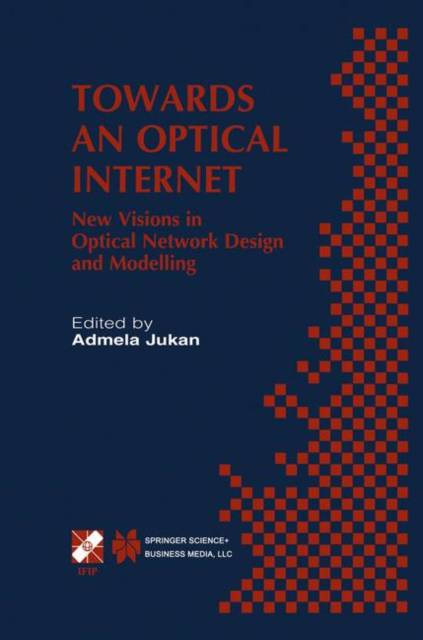
Towards an Optical Internet
New Visions in Optical Network Design and Modelling. Ifip Tc6 Fifth Working Conference on Optical Network Design and Modelling (Ondm 2001) February 5-7, 2001, Vienna, Austria
€ 199,45
+ 398 punten
Omschrijving
In these exciting times of quotidianly progressing developments in communication techniques, where more than ever in the history of a technological progress, society's reliance on communication networks for medicine, education, data transfer, commerce, and many other endeavours dominates the human's everyday life, the optical networks are certainly one of the most promising and challenging networking options. Since their commercial arrival in the nineties, they have fundamentally changed the way of dealing with traffic engineering by removing bandwidth bottlenecks and eliminating delays. Today, after the revolutionary bandwidth expansion, the networking functionality migrates more and more to the optical layer, and the need to establish fast wavelength circuits and capacity-on-demand for the higher-layer networks, in particular data networks based on Internet Protocol (IP), has become one of the central networking issues for the new century. The unifying trends toward configurable all-optical network infrastructure open up a wide range of new network engineering and design choices dealing with networks' interoperability and common platforms for control and management. The Fifth Working Conference on Optical Network Design and Modelling, held in the Austrian capital Vienna, February 5-7, 2001, aims at presenting the most recent progress in optical communication techniques, new technologies, standardisation process, emerging markets and carriers. A short look at the Table of Contents of this book tells us, in fact, that this year's conference program reflects the current state of the art precisely.
Specificaties
Betrokkenen
- Uitgeverij:
Inhoud
- Aantal bladzijden:
- 398
- Taal:
- Engels
- Reeks:
- Reeksnummer:
- nr. 76
Eigenschappen
- Productcode (EAN):
- 9780792375418
- Verschijningsdatum:
- 31/10/2001
- Uitvoering:
- Hardcover
- Formaat:
- Genaaid
- Afmetingen:
- 156 mm x 234 mm
- Gewicht:
- 757 g

Alleen bij Standaard Boekhandel
+ 398 punten op je klantenkaart van Standaard Boekhandel
Cadeau

AANGERADEN


Beoordelingen
We publiceren alleen reviews die voldoen aan de voorwaarden voor reviews. Bekijk onze voorwaarden voor reviews.