


- Afhalen na 1 uur in een winkel met voorraad
- Gratis thuislevering in België vanaf € 30
- Ruim aanbod met 7 miljoen producten
- Afhalen na 1 uur in een winkel met voorraad
- Gratis thuislevering in België vanaf € 30
- Ruim aanbod met 7 miljoen producten





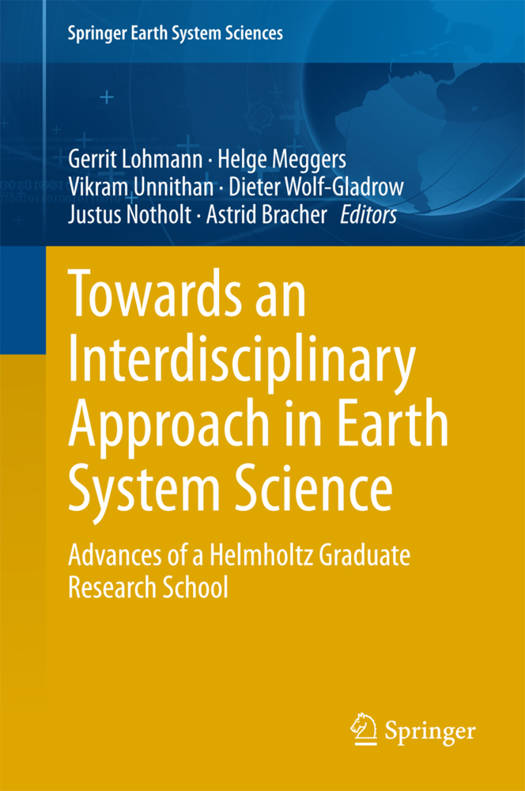
Towards an Interdisciplinary Approach in Earth System Science
€ 53,45
+ 106 punten
Omschrijving
This book describes the latest advances at the Helmholtz "Earth System Science Research School" where scientists from the Alfred Wegener Institute in Bremerhaven, the University of Bremen, and the Jacobs University are involved in research.
One of the greatest challenges is understanding ongoing environmental changes. The longer the time scale the more components of the Earth system are involved, e.g. interannual and decadal variations are related to the coupled atmosphere-ocean-sea ice system, whereas longer variations like glacial-interglacial or Cenozoic transitions involve the carbon cycle, ice sheets and gateways. In order to get deep insights into Earth system science, observations, remote sensing, past environmental data, as well as modeling need to be integrated. These different approaches are traditionally taught in separated disciplines at bachelor and master levels. It is, therefore, necessary to bring these disciplines together in PhD programs.
One of the greatest challenges is understanding ongoing environmental changes. The longer the time scale the more components of the Earth system are involved, e.g. interannual and decadal variations are related to the coupled atmosphere-ocean-sea ice system, whereas longer variations like glacial-interglacial or Cenozoic transitions involve the carbon cycle, ice sheets and gateways. In order to get deep insights into Earth system science, observations, remote sensing, past environmental data, as well as modeling need to be integrated. These different approaches are traditionally taught in separated disciplines at bachelor and master levels. It is, therefore, necessary to bring these disciplines together in PhD programs.
Specificaties
Betrokkenen
- Uitgeverij:
Inhoud
- Aantal bladzijden:
- 251
- Taal:
- Engels
- Reeks:
Eigenschappen
- Productcode (EAN):
- 9783319138640
- Verschijningsdatum:
- 2/02/2015
- Uitvoering:
- Paperback
- Formaat:
- Trade paperback (VS)
- Afmetingen:
- 156 mm x 234 mm
- Gewicht:
- 371 g

Alleen bij Standaard Boekhandel
+ 106 punten op je klantenkaart van Standaard Boekhandel
Wedstrijd


Beoordelingen
We publiceren alleen reviews die voldoen aan de voorwaarden voor reviews. Bekijk onze voorwaarden voor reviews.