


- Afhalen na 1 uur in een winkel met voorraad
- Gratis thuislevering in België vanaf € 30
- Ruim aanbod met 7 miljoen producten
- Afhalen na 1 uur in een winkel met voorraad
- Gratis thuislevering in België vanaf € 30
- Ruim aanbod met 7 miljoen producten





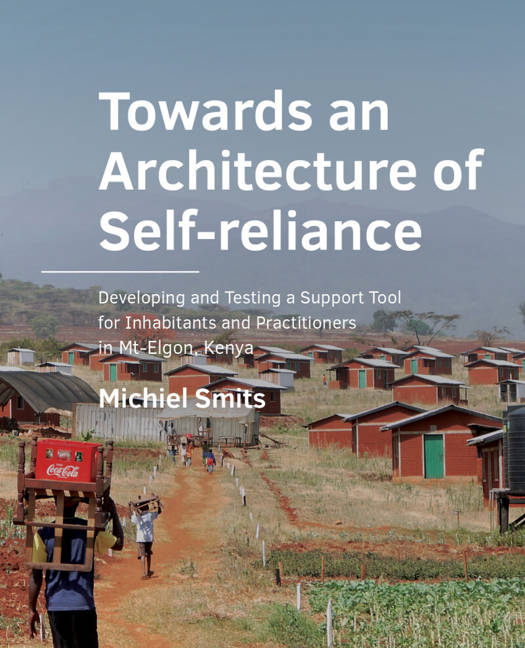
Towards an Architecture of Self-reliance
Developing and Testing a Support Tool for Inhabitants and Practitioners in Mt-Elgon, Kenya
Michiel Smits
€ 29,95
+ 59 punten
Omschrijving
This research project focuses on how decisions made by practitioners, articulating rural housing in Sub-Sahara Africa, contribute to the decreasing level of self-reliance inhabitants have regarding their housing. Multiple case studies on Mt. Elgon proved that inhabitants have a significantly higher self-reliance level, comparing traditional to modern housing. To study this phenomenon in practice and to articulate suitable design support the Design Research Methodology was chosen. The research clarification pinpointed inhabitant capacities as the key-contributor to self-reliant housing. Household survey outcomes proved that large numbers of rural inhabitant’s desire housing which they have insufficient capacities for. Indicating that the inhabitants experience a disparity between existing and desired housing capacities, moreover an inability to bridge this disparity independently, and consequently require external help.
Architect seemed most appropriate to offer this help as it consist of sociocultural, engineering and design tasks. Architects are not trained in inhabitant capacity evaluation and as no suitable design tools existed, this research project developed the required design support, its application requirements and the impact measurements. These were then tested in a pilot project on Mt. Elgon. The findings were used to evaluate the support’s impact and suitability. The support tool users found it suitable to assess and integrate inhabitant capacities into housing solutions. The impact shows that the support group families have sustained their family’s level of self-reliance unlike the control group. The developed technological design, with modifications, could be used not only in rural Kenyan communities, but also help others around the continent.
Architect seemed most appropriate to offer this help as it consist of sociocultural, engineering and design tasks. Architects are not trained in inhabitant capacity evaluation and as no suitable design tools existed, this research project developed the required design support, its application requirements and the impact measurements. These were then tested in a pilot project on Mt. Elgon. The findings were used to evaluate the support’s impact and suitability. The support tool users found it suitable to assess and integrate inhabitant capacities into housing solutions. The impact shows that the support group families have sustained their family’s level of self-reliance unlike the control group. The developed technological design, with modifications, could be used not only in rural Kenyan communities, but also help others around the continent.
Specificaties
Betrokkenen
- Auteur(s):
- Uitgeverij:
Inhoud
- Aantal bladzijden:
- 364
- Taal:
- Engels
- Reeks:
Eigenschappen
- Productcode (EAN):
- 9789463663342
- Verschijningsdatum:
- 10/11/2020
- Uitvoering:
- Paperback
- Afmetingen:
- 190 mm x 235 mm
- Gewicht:
- 837 g


Alleen bij Standaard Boekhandel
+ 59 punten op je klantenkaart van Standaard Boekhandel

Beoordelingen
We publiceren alleen reviews die voldoen aan de voorwaarden voor reviews. Bekijk onze voorwaarden voor reviews.