


- Afhalen na 1 uur in een winkel met voorraad
- Gratis thuislevering in België vanaf € 30
- Ruim aanbod met 7 miljoen producten
- Afhalen na 1 uur in een winkel met voorraad
- Gratis thuislevering in België vanaf € 30
- Ruim aanbod met 7 miljoen producten





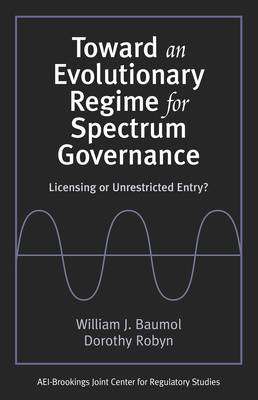
Toward an Evolutionary Regime for Spectrum Governance
Licensing or Unrestricted Entry?
William J Baumol, Dorothy Robyn
Paperback | Engels
€ 30,45
+ 60 punten
Omschrijving
The federal government's approach to regulating the spectrum remains largely administrative, causing major inefficiency and waste. Ironically, just as the FCC has begun to use market mechanisms, some people are pushing to treat spectrum as a common resource open to all entrants. Commons proponents maintain that with new, interference-avoiding technology, licensing is becoming unnecessary and impractical. In this brief study, noted economist William J. Baumol evaluates two options for spectrum governance--a tradable license (market) approach and a commons approach. He compares the practicality of each in terms of six key issues: interference, adequacy of investment in innovation, monopoly power, preservation of diversity, service to rural areas, and the tension between vested interests and the need for adaptable arrangements. Baumol demonstrates that, while neither approach is ideal, a commons regime has severe shortcomings. Above all, he emphasizes the importance of impermanence in the granting of licenses to preserve the flexibility to adapt to unforeseen technological and other developments.
Specificaties
Betrokkenen
- Auteur(s):
- Uitgeverij:
Inhoud
- Aantal bladzijden:
- 98
- Taal:
- Engels
Eigenschappen
- Productcode (EAN):
- 9780815708490
- Verschijningsdatum:
- 3/02/2006
- Uitvoering:
- Paperback
- Formaat:
- Trade paperback (VS)
- Afmetingen:
- 138 mm x 215 mm
- Gewicht:
- 117 g


Alleen bij Standaard Boekhandel
+ 60 punten op je klantenkaart van Standaard Boekhandel
Cadeau

AANGERADEN


Beoordelingen
We publiceren alleen reviews die voldoen aan de voorwaarden voor reviews. Bekijk onze voorwaarden voor reviews.