


- Afhalen na 1 uur in een winkel met voorraad
- Gratis thuislevering in België vanaf € 30
- Ruim aanbod met 7 miljoen producten
- Afhalen na 1 uur in een winkel met voorraad
- Gratis thuislevering in België vanaf € 30
- Ruim aanbod met 7 miljoen producten





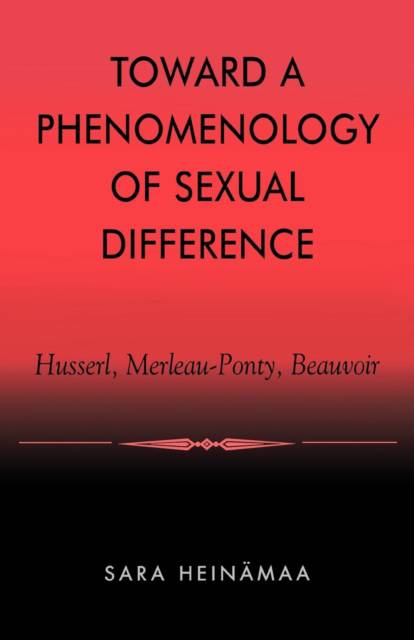
Toward a Phenomenology of Sexual Difference
Husserl, Merleau-Ponty, Beauvoir
Sara Heinämaa
Paperback | Engels
€ 93,45
+ 186 punten
Omschrijving
Simone de Beauvoir's Le Deuxi_me Sexe has been studied extensively since its appearance in 1949. Through the years, certain passages have taken on prestige; others are seen as unimportant to understanding Beauvoir's argument. In Toward a Phenomenology of Sexual Difference, Sara HeinSmaa rediscovers those neglected passages in her quest to follow Beauvoir's line of thinking. HeinSmaa, like some other recent philosophers, finds that Le Duexi_me Sexe is a philosophical inquiry, not the empirical study it is commonly thought to be. Others who view Beauvoir's masterpiece as a work of philosophy argue it is a criticism not only of Sartrean phenomenology, but of phenomenology as a whole. HeinSmaa thinks differently. She finds that Beauvoir's starting point is the Husserlian idea of the living body that she found developed in Merleau-Ponty's PhZnomZnologie de la perception. So when Beavoir wrote Le Duexi_me Sexe, she was writing not as Sartre's pupil, but as a scholar in the tradition of Husserl and Merleau-Ponty.
Specificaties
Betrokkenen
- Auteur(s):
- Uitgeverij:
Inhoud
- Aantal bladzijden:
- 182
- Taal:
- Engels
Eigenschappen
- Productcode (EAN):
- 9780847697854
- Verschijningsdatum:
- 1/01/2003
- Uitvoering:
- Paperback
- Formaat:
- Trade paperback (VS)
- Afmetingen:
- 137 mm x 215 mm
- Gewicht:
- 231 g



Alleen bij Standaard Boekhandel
+ 186 punten op je klantenkaart van Standaard Boekhandel
Cadeau

AANGERADEN


Beoordelingen
We publiceren alleen reviews die voldoen aan de voorwaarden voor reviews. Bekijk onze voorwaarden voor reviews.