


- Afhalen na 1 uur in een winkel met voorraad
- Gratis thuislevering in België vanaf € 30
- Ruim aanbod met 7 miljoen producten
- Afhalen na 1 uur in een winkel met voorraad
- Gratis thuislevering in België vanaf € 30
- Ruim aanbod met 7 miljoen producten





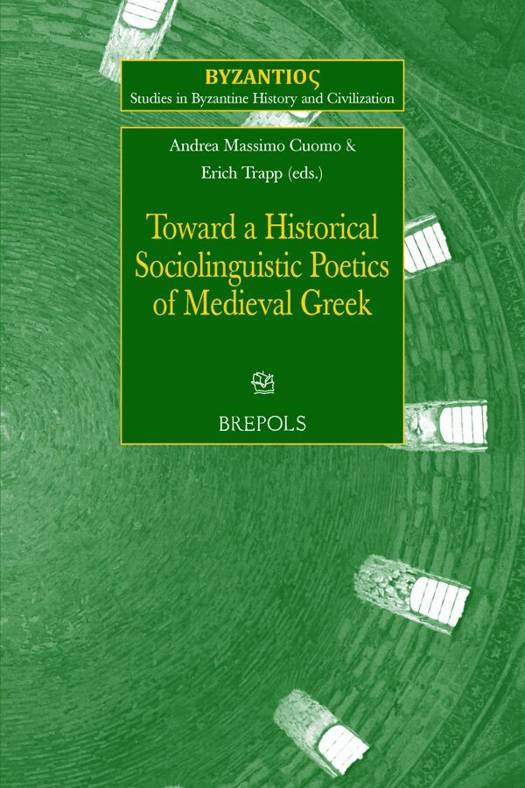
Toward a Historical Sociolinguistic Poetics of Medieval Greek
Andrea Cuomo
€ 74,20
+ 148 punten
Omschrijving
How can historical sociolinguistic analyses of Medieval Greek aid the interpretation of Medieval Greek texts? This is the main question that the papers collected in this volume aim to address. The term historical sociolinguistics (HSL), a discipline that combines linguistic, social, historical, and philological sciences, suggests that a language cannot be studied without its social dimension. Similarly, the study of a language in its social dimension is nothing else than the study of the communication which takes place between members of a given speech community by the means of written texts. These are seen as sets of shared signs used by authors to communicate to their audiences. This volume is divided into two distinct parts. In the first, Cuomo's and Bentein's papers aim to offer an overview on the discipline and examples of applied HSL. Valente's, Bianconi's, and Perez-Martin's papers will then show how to study the context of production and reception of Byzantine texts. These are followed by Horrocks' study on some features of Atticized Medieval Greek. In the second part, the contributions by Telelis, Odorico, and Manolova focus on the context of reception of the texts by Georgios Pachymeres, Theodoros Pediasimos, and Nikephoros Gregoras respectively.
Specificaties
Betrokkenen
- Auteur(s):
- Uitgeverij:
Inhoud
- Aantal bladzijden:
- 233
- Taal:
- Engels
- Reeks:
- Reeksnummer:
- nr. 12
Eigenschappen
- Productcode (EAN):
- 9782503577135
- Verschijningsdatum:
- 14/03/2018
- Uitvoering:
- Paperback
- Formaat:
- Trade paperback (VS)
- Afmetingen:
- 155 mm x 234 mm
- Gewicht:
- 748 g


Alleen bij Standaard Boekhandel
+ 148 punten op je klantenkaart van Standaard Boekhandel
Cadeau

AANGERADEN


Beoordelingen
We publiceren alleen reviews die voldoen aan de voorwaarden voor reviews. Bekijk onze voorwaarden voor reviews.