


- Afhalen na 1 uur in een winkel met voorraad
- Gratis thuislevering in België vanaf € 30
- Ruim aanbod met 7 miljoen producten
- Afhalen na 1 uur in een winkel met voorraad
- Gratis thuislevering in België vanaf € 30
- Ruim aanbod met 7 miljoen producten





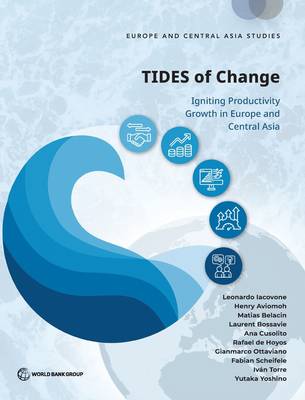
TIDES of Change (E)
Igniting Productivity Growth in Europe and Central Asia (E)
Gianmarco Ottaviano, Ana Cusolito, Iván Torre
€ 73,45
+ 146 punten
Omschrijving
Europe and Central Asia (ECA) stands at a critical juncture. After the global financial crisis, growth slowed sharply, overwhelmingly due to a collapse in productivity, while capital and labor contributions remained steady. Efficiency gaps now loom larger than capital gaps, with the widespread misallocation of labor and capital-- exacerbated by stalled reforms, weak market contestability, and the drag of underperforming state-owned enterprises-- holding back convergence. Drawing on a novel dataset of more than 40 million firm-level observations across sectors and countries, TIDES of Change: Restoring Prosperity Through Productivity shows that removing distortions could raise aggregate productivity by 30- 85 percent, with especially large gains in less advanced economies. The payoff is substantial: faster wage growth, more and better jobs, and a restored path to higher living standards. The report sets out a practical path to reignite convergence by riding the TIDES of higher productivity-- Trade, Investment, Digital, Efficiency, and Skills. It calls for reconnecting to dynamic markets and cutting trade costs; anchoring quality FDI and amplifying spillovers; turning connectivity into intensive digital use; leveling the playing field and unleashing reallocation; aligning talent and driving a lifelong upskilling. With limited fiscal space, first-best reforms and targeted support must be paired with stronger institutions that embed productivity at the core of national strategies. The central challenge in the region is not a lack of capital or connectivity, but their effective use.
Specificaties
Betrokkenen
- Auteur(s):
- Uitgeverij:
Inhoud
- Aantal bladzijden:
- 182
- Taal:
- Engels
- Reeks:
Eigenschappen
- Productcode (EAN):
- 9781464822872
- Verschijningsdatum:
- 16/12/2025
- Uitvoering:
- Paperback
- Formaat:
- Trade paperback (VS)
- Afmetingen:
- 198 mm x 266 mm
- Gewicht:
- 657 g


Alleen bij Standaard Boekhandel
+ 146 punten op je klantenkaart van Standaard Boekhandel
Cadeau

AANGERADEN


Beoordelingen
We publiceren alleen reviews die voldoen aan de voorwaarden voor reviews. Bekijk onze voorwaarden voor reviews.