


- Afhalen na 1 uur in een winkel met voorraad
- Gratis thuislevering in België vanaf € 30
- Ruim aanbod met 7 miljoen producten
- Afhalen na 1 uur in een winkel met voorraad
- Gratis thuislevering in België vanaf € 30
- Ruim aanbod met 7 miljoen producten





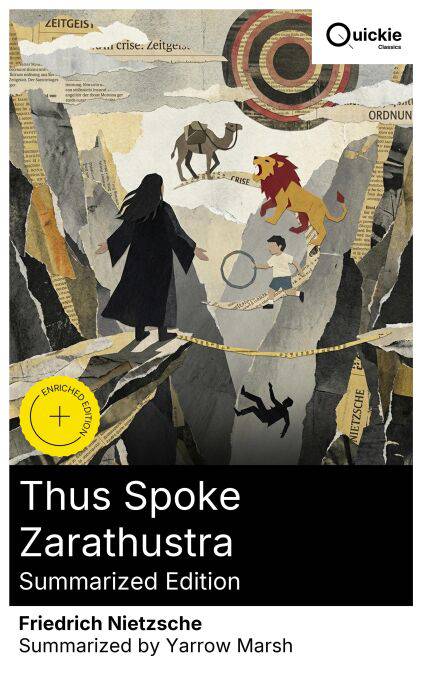
Thus Spoke Zarathustra (Summarized Edition) E-BOOK
Enriched edition. Poetic, aphoristic parables of the Übermensch, eternal recurrence, and the will to power
Friedrich Nietzsche
E-book | Engels
€ 1,99
+ 1 punten
Omschrijving
Thus Spoke Zarathustra is Nietzsche's audacious fusion of philosophy and prophetic drama, composed in four parts (1883–1885). In parables—the tightrope walker's fall, the "three metamorphoses" from camel to lion to child—and a quasi-biblical cadence, Zarathustra descends to proclaim the Übermensch, will to power, and eternal recurrence. At once parody of scripture and hymn to self-overcoming, it confronts Europe's fin-de-siècle value crisis after the "death of God," anticipating modernism and remaking the philosophical voice. Once a brilliant classical philologist at Basel, Nietzsche wrote amid illness, solitude, and itinerant Alpine winters after breaking with Wagner and Schopenhauer's pessimism. The Sils-Maria insight of 1881 crystallized eternal recurrence; engagement with Greek tragedy, Heraclitus, and the pre-Socratics furnished a vocabulary of flux and affirmation. Zarathustra is the mask through which he dramatizes experiments in valuation while rejecting academic system-building. This book rewards readers who embrace its aphoristic leaps and musical refrains: read slowly, aloud, and cyclically, letting motifs return. Essential for students of philosophy, theology, and literature, it offers bracing resources for self-transformation amid cultural disorientation. Approach it not to receive doctrines, but to practice thinking otherwise.
Quickie Classics summarizes timeless works with precision, preserving the author's voice and keeping the prose clear, fast, and readable—distilled, never diluted. Enriched Edition extras: Introduction · Synopsis · Historical Context · Author Biography · Brief Analysis · 4 Reflection Q&As · Editorial Footnotes.
Quickie Classics summarizes timeless works with precision, preserving the author's voice and keeping the prose clear, fast, and readable—distilled, never diluted. Enriched Edition extras: Introduction · Synopsis · Historical Context · Author Biography · Brief Analysis · 4 Reflection Q&As · Editorial Footnotes.
Specificaties
Betrokkenen
- Auteur(s):
- Vertaler(s):
- Uitgeverij:
Inhoud
- Aantal bladzijden:
- 120
- Taal:
- Engels
Eigenschappen
- Productcode (EAN):
- 8596547875543
- Verschijningsdatum:
- 11/01/2026
- Uitvoering:
- E-book
- Beveiligd met:
- Digital watermarking
- Formaat:
- ePub


Alleen bij Standaard Boekhandel
+ 1 punten op je klantenkaart van Standaard Boekhandel

Beoordelingen
We publiceren alleen reviews die voldoen aan de voorwaarden voor reviews. Bekijk onze voorwaarden voor reviews.