


- Afhalen na 1 uur in een winkel met voorraad
- Gratis thuislevering in België vanaf € 30
- Ruim aanbod met 7 miljoen producten
- Afhalen na 1 uur in een winkel met voorraad
- Gratis thuislevering in België vanaf € 30
- Ruim aanbod met 7 miljoen producten





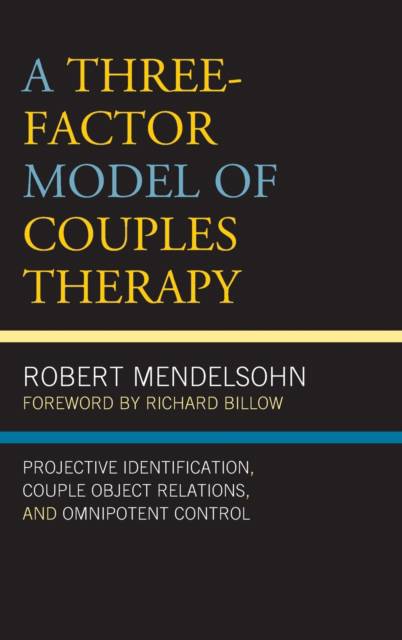
Three-Factor Model of Couples Therapy
Projective Identification, Couple Object Relations, and Omnipotent Control
Robert Mendelsohn
€ 220,45
+ 440 punten
Omschrijving
Couple psychotherapy extends the work of the psychotherapist to the patient's most significant committed adult relationship, yet the therapy is difficult both conceptually and technically. One major reason for this difficulty is that in every couple's treatment there is a confusing array of psychological defenses as well as regressive and nonregressive couple object relations-as distinct from the object relations that each individual member brings to the couple. Further, many of these processes are occurring outside consciousness and at the very same time. This book is an attempt to clarify all the confusing issues by presenting a three-factor model of couple psychotherapy within a psychodynamic framework. This model has been found to be very effective with many different kinds of couples. The book suggests that there are three powerful couple dynamics that shape every couple's treatment: (A) the quality and quantity of the couple's projective identifications; (B) the level of their "couple object relations"; and (C) the presence or absence of the defense of omnipotent control. These three variables are the most important factors in the therapy; they determine the success or failure of every therapy with every couple. These dynamics also determine quite a bit about how to conduct a couple therapy with regard to the therapist's level of activity, tone, the way of sorting the material in his or her head, and even the kinds of interventions he/she chooses (whether or not, for example, the therapist will use certain resistance techniques). Understanding these three variables and how they interact is key to the success of the therapy.
Specificaties
Betrokkenen
- Auteur(s):
- Uitgeverij:
Inhoud
- Aantal bladzijden:
- 284
- Taal:
- Engels
- Reeks:
Eigenschappen
- Productcode (EAN):
- 9781498557078
- Verschijningsdatum:
- 7/08/2017
- Uitvoering:
- Hardcover
- Formaat:
- Genaaid
- Afmetingen:
- 155 mm x 231 mm
- Gewicht:
- 612 g



Alleen bij Standaard Boekhandel
+ 440 punten op je klantenkaart van Standaard Boekhandel
CADEAU

AANGERADEN


Beoordelingen
We publiceren alleen reviews die voldoen aan de voorwaarden voor reviews. Bekijk onze voorwaarden voor reviews.