


- Afhalen na 1 uur in een winkel met voorraad
- Gratis thuislevering in België vanaf € 30
- Ruim aanbod met 7 miljoen producten
- Afhalen na 1 uur in een winkel met voorraad
- Gratis thuislevering in België vanaf € 30
- Ruim aanbod met 7 miljoen producten





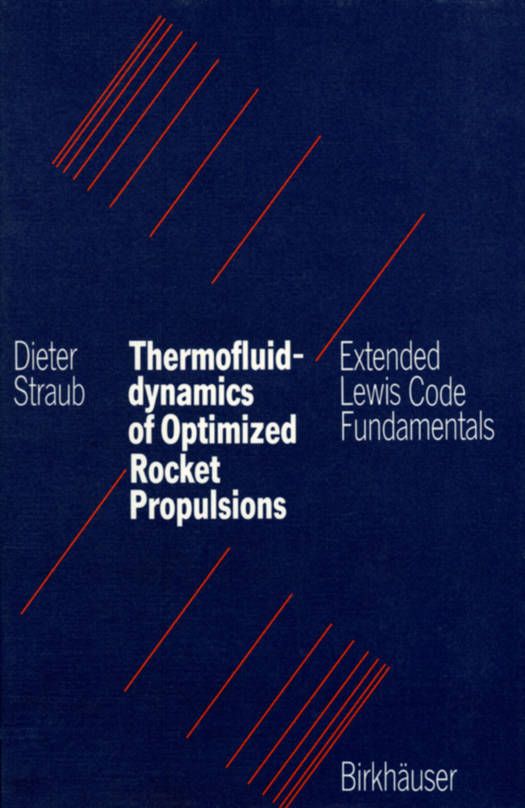
Thermofluiddynamics of Optimized Rocket Propulsions
Extended Lewis Code Fundamentals
Straub
Paperback | Engels
€ 72,59
+ 145 punten
Omschrijving
This study has two declared aims: it presents the theoretical basis for a provably ideal comparative process for relaxing flows (ICP) and jus- tifies its application to jet and, in particular, rocket engines. This will be treated in two parts. Part I offers a status quo report on current calculation methods, and compiles and explains briefly the most important data on selected pro- minent rocket engines. Starting from the phenomenology of the dynamical and physico-chemical conversion processes in the fuel-oxidizer fluid mixture and in the burned gases, the ideal thermodynamic comparative process is then derived - as a defined sequential change of states in the system. In order to render this comparative process readily under- standable, it is first applied to an appropriate model gas using alge- braic equations for all relevant parameters. This model gas undergoes energy conversion processes without forfeiting the simplicity of pre- sentation typical of classical gas dynamics. Above all, examination of this model offers proof that it is generally impermissible to use, as is done in practice, the familiar isentropic equation for flow changes of state continuously propagated in flow tube theory. Elementary calculations immediately indicate essential attributes which are also typical for relaxing, multicomponent, one-phase systems, such as the significant 'pressure drop phenomenon' or the establishment of the steady mass flow rate as an 'eigenvalue' of the comparative pro- cess. Their relevance to the RE theory is stressed.
Specificaties
Betrokkenen
- Auteur(s):
- Uitgeverij:
Inhoud
- Aantal bladzijden:
- 266
- Taal:
- Engels
Eigenschappen
- Productcode (EAN):
- 9783034899277
- Verschijningsdatum:
- 23/09/2011
- Uitvoering:
- Paperback
- Formaat:
- Trade paperback (VS)
- Afmetingen:
- 152 mm x 229 mm
- Gewicht:
- 367 g


Alleen bij Standaard Boekhandel
+ 145 punten op je klantenkaart van Standaard Boekhandel
CADEAU


Beoordelingen
We publiceren alleen reviews die voldoen aan de voorwaarden voor reviews. Bekijk onze voorwaarden voor reviews.