


- Afhalen na 1 uur in een winkel met voorraad
- Gratis thuislevering in België vanaf € 30
- Ruim aanbod met 7 miljoen producten
- Afhalen na 1 uur in een winkel met voorraad
- Gratis thuislevering in België vanaf € 30
- Ruim aanbod met 7 miljoen producten





€ 91,95
+ 183 punten
Omschrijving
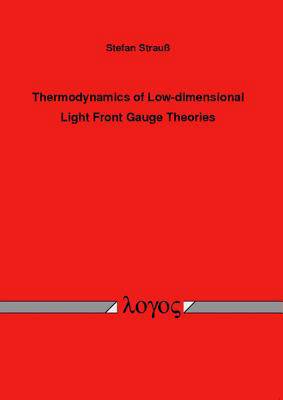
In this thesis a consistent non-perturbative application of light cone quantization for the thermodynamics of strongly coupled quantum field theories is presented. Non-perturbative methods are mandatory for a description of physical systems under extreme conditions such as the fire ball occurring during heavy ion collisions or the plasma of the early universe. Using the general light cone frame, it is shown that thermodynamic properties can be meaningfully determined in the framework of light cone quantized Hamiltonian field theory. This work focuses on Quantum Electrodynamics (QED1+1/massive Schwinger model) and Quantum Chromodynamics in 1 + 1 dimensions to compute thermodynamic observables in an ab initio approach. The central quantity is the partition function Z used to derive all other observables, e.g. the equation of state, by standard relations. Due to the increased numerical effort and new solution algorithms the accuracy on low lying bound state masses of the massive Schwinger model could be improved by almost two orders of magnitude compared to previous light cone calculations. Finally, a possible application of the density matrix renormalization group to the massive Schwinger model has been explored.
Specificaties
Betrokkenen
- Auteur(s):
- Uitgeverij:
Inhoud
- Aantal bladzijden:
- 126
- Taal:
- Engels
Eigenschappen
- Productcode (EAN):
- 9783832523978
- Verschijningsdatum:
- 28/02/2010
- Uitvoering:
- Paperback
- Formaat:
- Trade paperback (VS)
- Afmetingen:
- 145 mm x 211 mm
- Gewicht:
- 511 g


Alleen bij Standaard Boekhandel
+ 183 punten op je klantenkaart van Standaard Boekhandel

Beoordelingen
We publiceren alleen reviews die voldoen aan de voorwaarden voor reviews. Bekijk onze voorwaarden voor reviews.