


- Afhalen na 1 uur in een winkel met voorraad
- Gratis thuislevering in België vanaf € 30
- Ruim aanbod met 7 miljoen producten
- Afhalen na 1 uur in een winkel met voorraad
- Gratis thuislevering in België vanaf € 30
- Ruim aanbod met 7 miljoen producten





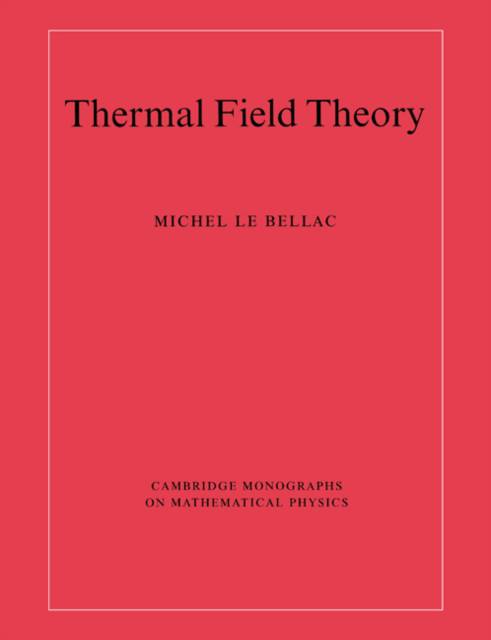
Thermal Field Theory
Michel Le Bellac
€ 142,95
+ 285 punten
Omschrijving
This text introduces the theoretical framework for describing the quark-gluon plasma, an important new state of matter. The first part of the book is a self-contained introduction to relativistic thermal field theory. Topics include the path integral approach, the real and imaginary time formalisms, fermion fields and gauge fields at finite temperature. The author illustrates useful techniques such as the evaluation of frequency sums and the use of cutting rules. The second part of the book is devoted to recent developments, and gives a detailed account of collective excitations (bosonic and fermionic), showing how they give rise to energy scales that imply a reorganization of perturbation theory. The author also explains the relation with kinetic theory. He works out in detail applications to processes that occur in heavy ion collisions and in astrophysics. Each chapter ends with exercises and a guide to the literature. Graduate students and researchers in nuclear, particle, and astrophysics will benefit from this book.
Specificaties
Betrokkenen
- Auteur(s):
- Uitgeverij:
Inhoud
- Aantal bladzijden:
- 272
- Taal:
- Engels
- Reeks:
Eigenschappen
- Productcode (EAN):
- 9780521654777
- Verschijningsdatum:
- 03/07/2000
- Uitvoering:
- Paperback
- Formaat:
- Trade paperback (VS)
- Afmetingen:
- 175 mm x 247 mm
- Gewicht:
- 453 g


Alleen bij Standaard Boekhandel
+ 285 punten op je klantenkaart van Standaard Boekhandel
Cadeau

AANGERADEN


Beoordelingen
We publiceren alleen reviews die voldoen aan de voorwaarden voor reviews. Bekijk onze voorwaarden voor reviews.