


- Afhalen na 1 uur in een winkel met voorraad
- Gratis thuislevering in België vanaf € 30
- Ruim aanbod met 7 miljoen producten
- Afhalen na 1 uur in een winkel met voorraad
- Gratis thuislevering in België vanaf € 30
- Ruim aanbod met 7 miljoen producten





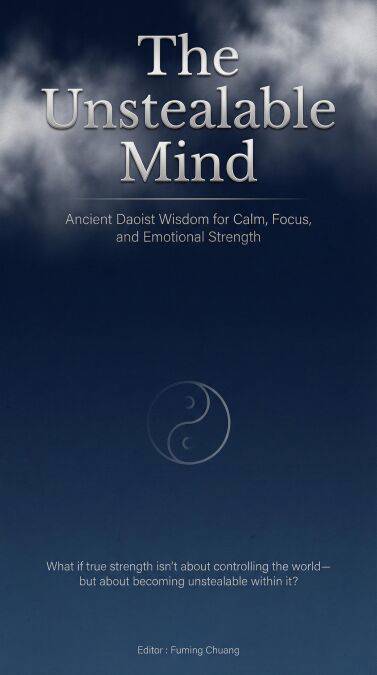
The Unstealable Mind: Ancient Daoist Wisdom for Calm, Focus, and Emotional Strength E-BOOK
Fuming Chuang
€ 5,99
+ 5 punten
Omschrijving
This is not a book that tells you what to believe.
It is a book that invites you to reconsider how to live.
In a modern society defined by acceleration, over-connection, and constant competition, people are more prone than ever to losing their sense of direction. As the external world grows increasingly precise and complex, the inner world becomes ever harder to settle: anxiety turns into a norm, exhaustion is rationalized, and disorder is mistaken for efficiency.
Living with Simplicity emerges from this very condition. It does not offer a checklist of solutions, nor does it promise rapid transformation. Instead, it returns to a more fundamental question: when everything demands that you be faster, stronger, and more efficient, are you still able to live without being depleted?
At the heart of this book lies the idea of "holding to the uncarved"—not as a nostalgic retreat, but as a lived capacity to preserve what is essential amid complexity. "Simplicity" here does not mean crude minimalism or withdrawal, but that part of oneself which remains intact after excess has been stripped away. To "hold" is not to cling blindly, but to know clearly what is worth sustaining over time.
What this book explores is not abstract philosophy, but recurring realities of modern life:
How do we compete without losing ourselves?
How do we pursue goals without exhausting our inner reserves?
How do we cultivate stability in an uncertain world without relying on external validation?
Through calm and measured writing, the book suggests that true order does not arise from controlling everything, but from understanding one's own rhythm, boundaries, and limits of endurance. When one learns when to stop, how to reduce unnecessary expenditure, and how to remain rooted, the inner world can retain room to breathe—even amid external turbulence.
Living with Simplicity does not ask readers to adopt a particular worldview, nor does it presume any belief system. It may be read as a slow and honest conversation—one held with oneself, and with others who have already sensed that excessive effort does not necessarily lead to a better life.
In an age of disorder, true maturity may not lie in constant accumulation, but in knowing what to preserve;
not in endless self-proof, but in the ability to remain at ease;
not in escaping the world, but in staying rooted while living fully within it.
Specificaties
Betrokkenen
- Auteur(s):
- Uitgeverij:
Inhoud
- Taal:
- Engels
- Reeks:
Eigenschappen
- Productcode (EAN):
- 9798233438899
- Verschijningsdatum:
- 10/01/2026
- Uitvoering:
- E-book
- Formaat:
- ePub


Alleen bij Standaard Boekhandel
+ 5 punten op je klantenkaart van Standaard Boekhandel
Cadeau

AANGERADEN


Beoordelingen
We publiceren alleen reviews die voldoen aan de voorwaarden voor reviews. Bekijk onze voorwaarden voor reviews.