


- Afhalen na 1 uur in een winkel met voorraad
- Gratis thuislevering in België vanaf € 30
- Ruim aanbod met 7 miljoen producten
- Afhalen na 1 uur in een winkel met voorraad
- Gratis thuislevering in België vanaf € 30
- Ruim aanbod met 7 miljoen producten





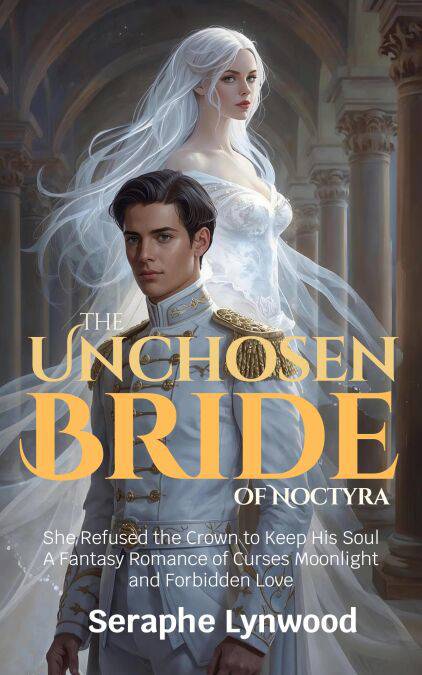
The Unchosen Bride of Noctyra: She Refused the Crown to Keep His Soul A Fantasy Romance of Curses Moonlight and Forbidden Love E-BOOK
Seraphe Lynwood
E-book | Engels
€ 8,99
+ 8 punten
Eenvoudig bestellen
Veilig betalen


Onmiddellijk geleverd via e-mail
Omschrijving
Lucien Aurelian was raised to believe that stability is a form of virtue.
That restraint keeps the world intact.
That silence, when held long enough, becomes consent.
The palace he inhabits is built on these assumptions—stone corridors that remember footsteps, rituals that move forward whether anyone wishes them to or not, and laws older than compassion that decide what is allowed to exist without ever asking whether existence itself was chosen. Lucien has learned to survive within this architecture by aligning his body, moderating his breath, and keeping desire small enough not to disrupt the order that depends on his compliance.
Then something enters his life that does not fit.
It does not announce itself as salvation.
It does not promise safety.
It simply exists—close enough to alter his breathing, close enough to create pressure where none was meant to form.
What begins as proximity becomes tension. What tension becomes attachment. And attachment, in this world, is not neutral.
As Lucien moves deeper into the mechanisms that govern his reality—ancient rules, inherited obligations, ceremonies that proceed without consent—he begins to understand that love is not forbidden because it is dangerous, but because it makes the cost visible. To care is to add weight to a structure already under strain. To stay is to accelerate consequences that can no longer be delayed.
This is not a story about rebellion in flames or crowns torn from thrones.
It is a story about quieter defiance: the refusal to disappear cleanly, the decision to remain present when absence would be easier for everyone else. It follows a man who must decide whether survival means obedience, and whether choosing another person can ever be separated from choosing oneself.
The Unchosen Bride of Noctyra is a literary fantasy romance rooted in atmosphere, bodily awareness, and emotional pressure. It explores power not as spectacle, but as something that presses into the chest, alters breath, and asks for compliance through silence. Love here is not a promise of rescue—it is risk, friction, and the willingness to stay even when the world withdraws its permission.
In a world that offers no harmless choices, Lucien must decide what it means to exist intact—and whether integrity is something granted by systems, or something claimed despite them.
Specificaties
Betrokkenen
- Auteur(s):
- Uitgeverij:
Inhoud
- Taal:
- Engels
Eigenschappen
- Productcode (EAN):
- 9798233908224
- Verschijningsdatum:
- 8/01/2026
- Uitvoering:
- E-book
- Formaat:
- ePub


Alleen bij Standaard Boekhandel
+ 8 punten op je klantenkaart van Standaard Boekhandel
CADEAU

AANGERADEN


Beoordelingen
We publiceren alleen reviews die voldoen aan de voorwaarden voor reviews. Bekijk onze voorwaarden voor reviews.