


- Afhalen na 1 uur in een winkel met voorraad
- Gratis thuislevering in België vanaf € 30
- Ruim aanbod met 7 miljoen producten
- Afhalen na 1 uur in een winkel met voorraad
- Gratis thuislevering in België vanaf € 30
- Ruim aanbod met 7 miljoen producten





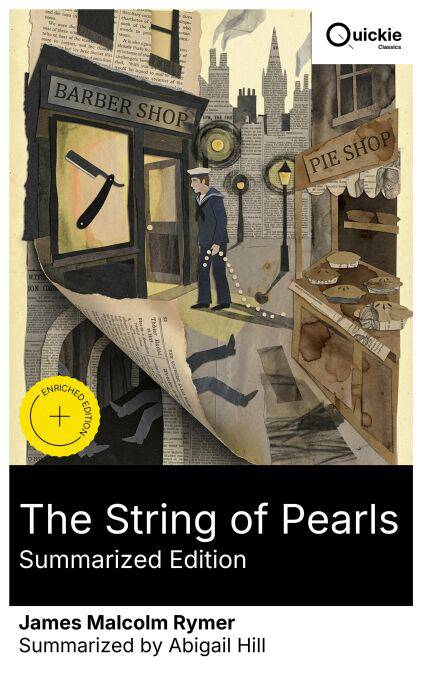
The String of Pearls (Summarized Edition) E-BOOK
Enriched edition. Victorian London Gothic: a murderous barber, sinister meat pies, and secrets in underground passages.
James Malcolm Rymer
E-book | Engels
€ 1,99
+ 1 punten
Eenvoudig bestellen
Veilig betalen


Onmiddellijk geleverd via e-mail
Omschrijving
The String of Pearls inaugurates the legend of Sweeney Todd, the demon barber of Fleet Street, in a heady blend of urban Gothic, crime fiction, and sensational melodrama. Serialized in a penny weekly in 1846–47, the novel fuses labyrinthine London topography with a suspense engine of cliffhangers, shifting viewpoints, and theatrical set‑pieces. Its plot—pirated wealth condensed into the titular pearls, sailors vanished, customers dispatched through a barber's chair to become Mrs. Lovett's infamous pies—exposes anxieties about imperial plunder, class exploitation, and the mechanization of appetite and commerce. Stylistically brisk and lurid, yet thematically pointed, it stands at the crossroads of the Newgate novel and the Victorian city mystery, anticipating later urban Gothic by converting everyday trades into engines of terror. James Malcolm Rymer, a prolific master of the Victorian "penny dreadful," honed techniques of serial suspense within Edward Lloyd's publishing stable and elsewhere. His instinct for cliffhangers, vivid crowd scenes, and moral chiaroscuro—evident across his vast output, including Varney the Vampire—reflects an acute feel for working‑class readerships and for the press-fueled spectacle of metropolitan crime. The constraints and opportunities of serialization shaped his pacing, while the era's theatrical melodrama lent his prose its kinetic immediacy. Scholars of popular fiction, Gothic aficionados, and historians of media will find this a foundational text: a gripping, darkly comic anatomy of Victorian modernity whose influence, from stage to screen, still sharpens our taste for horror and social critique.
Quickie Classics summarizes timeless works with precision, preserving the author's voice and keeping the prose clear, fast, and readable—distilled, never diluted. Enriched Edition extras: Introduction · Synopsis · Historical Context · Brief Analysis · 4 Reflection Q&As · Editorial Footnotes.
Quickie Classics summarizes timeless works with precision, preserving the author's voice and keeping the prose clear, fast, and readable—distilled, never diluted. Enriched Edition extras: Introduction · Synopsis · Historical Context · Brief Analysis · 4 Reflection Q&As · Editorial Footnotes.
Specificaties
Betrokkenen
- Auteur(s):
- Uitgeverij:
Inhoud
- Aantal bladzijden:
- 105
- Taal:
- Engels
Eigenschappen
- Productcode (EAN):
- 8596547882992
- Verschijningsdatum:
- 9/01/2026
- Uitvoering:
- E-book
- Beveiligd met:
- Digital watermarking
- Formaat:
- ePub


Alleen bij Standaard Boekhandel
+ 1 punten op je klantenkaart van Standaard Boekhandel
CADEAU

AANGERADEN


Beoordelingen
We publiceren alleen reviews die voldoen aan de voorwaarden voor reviews. Bekijk onze voorwaarden voor reviews.