


- Afhalen na 1 uur in een winkel met voorraad
- Gratis thuislevering in België vanaf € 30
- Ruim aanbod met 7 miljoen producten
- Afhalen na 1 uur in een winkel met voorraad
- Gratis thuislevering in België vanaf € 30
- Ruim aanbod met 7 miljoen producten





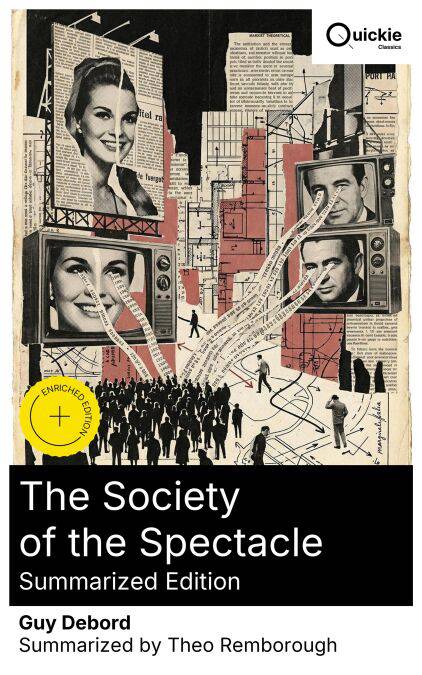
The Society of the Spectacle (Summarized Edition) E-BOOK
Enriched edition. Critical and Marxist critique of media-driven consumerism and alienation; an aphoristic, radical manifesto from 1968 Paris
Guy Debord
E-book | Engels
€ 1,99
+ 1 punten
Omschrijving
First published in 1967, The Society of the Spectacle advances a critique of late capitalist modernity, arguing that social relations are mediated by images and commodities. Cast as 221 theses, its style is aphoristic and dialectical, fusing Marx, Hegel, and Lukács with avant‑garde tactics. Debord defines the spectacle as a social relation, restructuring perception, urban space, and desire. Situated on the eve of 1968, it weds Marxist theory to experimental prose and agitation. Guy Debord, a French theorist and filmmaker, co‑founded the Situationist International after work with the Lettrists. Practices of dérive, psychogeography, and détournement shaped both method and target: the commodification of everyday life. Years of militant editing, polemics, and montage‑based films trained his terse, citation‑rich voice, while the rise of television, advertising, and spectacular urbanism supplied the empirical ground for these uncompromising theses. This book rewards readers of critical theory, media studies, and political philosophy seeking concepts for platform capitalism and algorithmic attention. Demanding yet lucid, it invites close reading, group discussion, and application to struggles over work, city life, and representation. Read alongside Debord's later Comments and Situationist texts, it remains an indispensable guide to seeing—and resisting—the spectacle.
Quickie Classics summarizes timeless works with precision, preserving the author's voice and keeping the prose clear, fast, and readable—distilled, never diluted. Enriched Edition extras: Introduction · Synopsis · Historical Context · Author Biography · Brief Analysis · 4 Reflection Q&As · Editorial Footnotes.
Quickie Classics summarizes timeless works with precision, preserving the author's voice and keeping the prose clear, fast, and readable—distilled, never diluted. Enriched Edition extras: Introduction · Synopsis · Historical Context · Author Biography · Brief Analysis · 4 Reflection Q&As · Editorial Footnotes.
Specificaties
Betrokkenen
- Auteur(s):
- Vertaler(s):
- Uitgeverij:
Inhoud
- Aantal bladzijden:
- 64
- Taal:
- Engels
Eigenschappen
- Productcode (EAN):
- 8596547879343
- Verschijningsdatum:
- 9/01/2026
- Uitvoering:
- E-book
- Beveiligd met:
- Digital watermarking
- Formaat:
- ePub


Alleen bij Standaard Boekhandel
+ 1 punten op je klantenkaart van Standaard Boekhandel
AANGERADEN


Beoordelingen
We publiceren alleen reviews die voldoen aan de voorwaarden voor reviews. Bekijk onze voorwaarden voor reviews.